Table of Contents
Introduction
Poor sleep and muscle growth are directly connected — and it’s a connection most lifters completely ignore. You can nail your training program, hit your protein targets, and still barely progress if you’re consistently running on 5–6 hours of sleep a night.
That’s because muscle isn’t actually built in the gym. Training just creates the stimulus. The real construction work — repairing muscle fibers, releasing growth hormone, consolidating strength adaptations — happens while you sleep. Skimp on sleep, and you’re skipping the part of the process where the actual growth happens.
Let’s look at exactly how poor sleep and muscle growth interact, the signs that sleep is sabotaging your results, and what to do about it.
How Sleep Affects Muscle Growth and Recovery
During deep sleep, your body releases the majority of its daily growth hormone, a key driver of muscle repair and growth. Sleep is also when muscle protein synthesis — the process that rebuilds muscle fibers damaged during training — is at its most active.
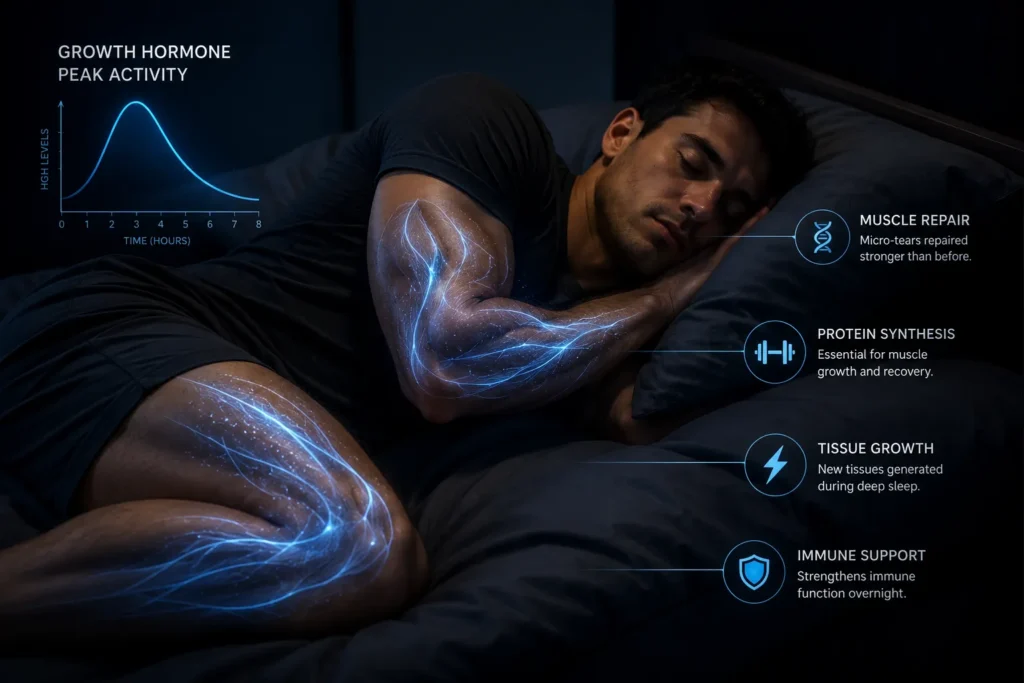
At the same time, poor sleep raises cortisol, a stress hormone that, when chronically elevated, works against muscle growth and can even contribute to muscle breakdown. In short: good sleep creates the hormonal environment muscle growth needs; poor sleep actively works against it.
Why Poor Sleep Is Killing Your Gym Gains
Here’s what happens, step by step, when sleep quality or quantity drops:
- Lower growth hormone release, since most of it is secreted during deep sleep stages you’re missing out on
- Higher cortisol levels, which can promote muscle breakdown and make fat loss harder
- Reduced workout performance, since strength, power, and endurance all drop noticeably after poor sleep
- Slower recovery between sessions, meaning more accumulated fatigue and a higher injury risk
- Increased hunger and cravings, driven by disrupted hunger hormones (ghrelin and leptin), which can sabotage nutrition goals
- Reduced motivation and focus, making it harder to train with the intensity needed for real progress
For more strategies on keeping your performance optimized despite setbacks, check out our guide on Gym Performance Tracking.
How Much Sleep Do You Actually Need?
Most adults need 7–9 hours of quality sleep per night for optimal recovery, though people who train intensely often benefit from being on the higher end of that range. Athletes in strength and hypertrophy-focused programs frequently perform noticeably better with 8+ hours consistently.
More important than the exact number is consistency: going to bed and waking up at roughly the same time every day helps regulate your body’s hormone release patterns far more effectively than sleeping 10 hours one night and 5 the next.
It’s also worth noting that sleep quality matters just as much as sleep quantity. Someone who spends 8 hours in bed but wakes up repeatedly, or rarely reaches deep sleep due to alcohol, late caffeine, or a noisy environment, may still show many of the same signs as someone who simply sleeps too few hours. If you’re already hitting 7–9 hours but still feel exhausted and see stalled progress, it’s worth looking at sleep quality — not just total time in bed — as the next variable to fix.
Signs Poor Sleep Is Sabotaging Your Training
- Your lifts have stalled or regressed despite consistent training and good nutrition
- You feel constantly fatigued, even on days you didn’t train
- Your resting heart rate is noticeably higher than usual
- You’re more irritable, unmotivated, or mentally foggy than normal
- You’re taking longer to recover between workouts, with lingering soreness
- Your appetite and cravings feel harder to control than usual
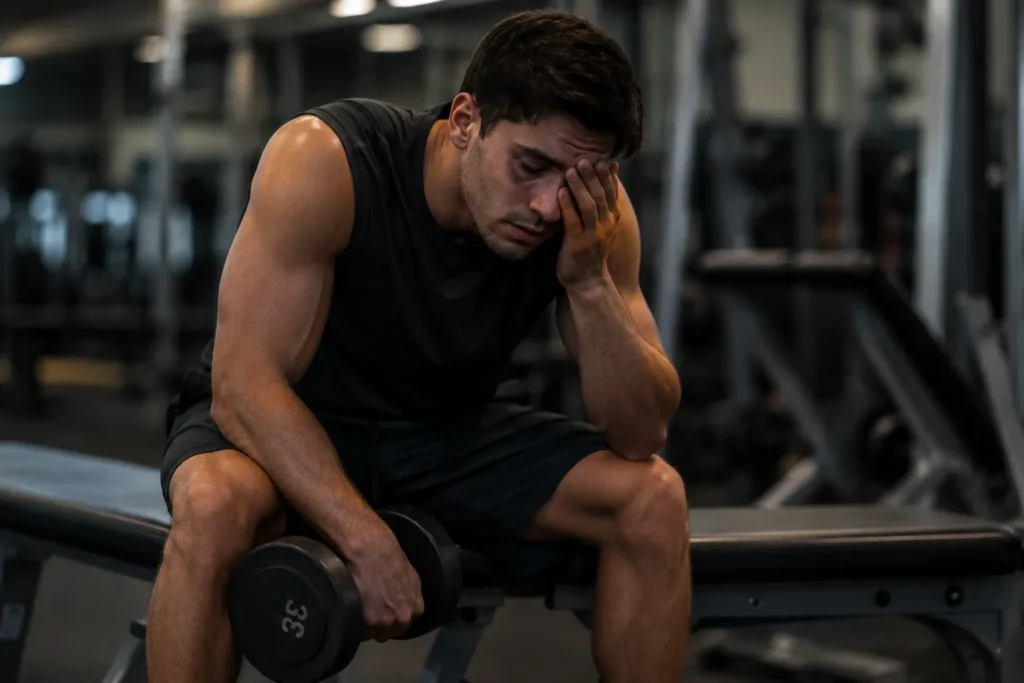
If several of these sound familiar, poor sleep — not your training program — is very likely the missing variable.
How to Improve Sleep for Better Gym Results
- Keep a consistent sleep schedule, even on weekends, to stabilize your body’s internal clock
- Cut caffeine after early afternoon, since it can disrupt deep sleep even if you fall asleep fine
- Limit screens 30–60 minutes before bed, as blue light delays melatonin release
- Keep your bedroom cool and dark, ideally between 18–20°C (64–68°F), for deeper sleep stages
- Build a simple wind-down routine — reading, stretching, or a shower — to signal to your body it’s time to rest
- Avoid heavy meals or intense training too close to bedtime, since both can raise core temperature and delay sleep onset

For additional science-backed recovery protocols, you can explore external insights from trusted authorities like the National Sleep Foundation and Examine.com.
The Feedback Loop Between Sleep, Training, and Recovery
It’s worth understanding that this relationship works both ways. Poor sleep hurts training, but poorly timed training can also hurt sleep. Training late at night at very high intensity, for example, can raise core temperature and alertness enough to make falling asleep harder afterward — creating a loop where bad workouts lead to bad nights, which lead to even worse workouts.
That’s why treating sleep as part of your training program, rather than something separate from it, makes such a difference. Just like you track weight, reps, and sets in your workout log, it’s worth tracking hours of sleep and how you felt the next day. After a few weeks of data, it usually becomes clear whether a workout that’s too late, a poorly slept night, or a badly planned rest day is behind a weak session — instead of automatically assuming the problem is “lack of effort” or “the wrong program.”
Are Sleep Trackers Worth Using?
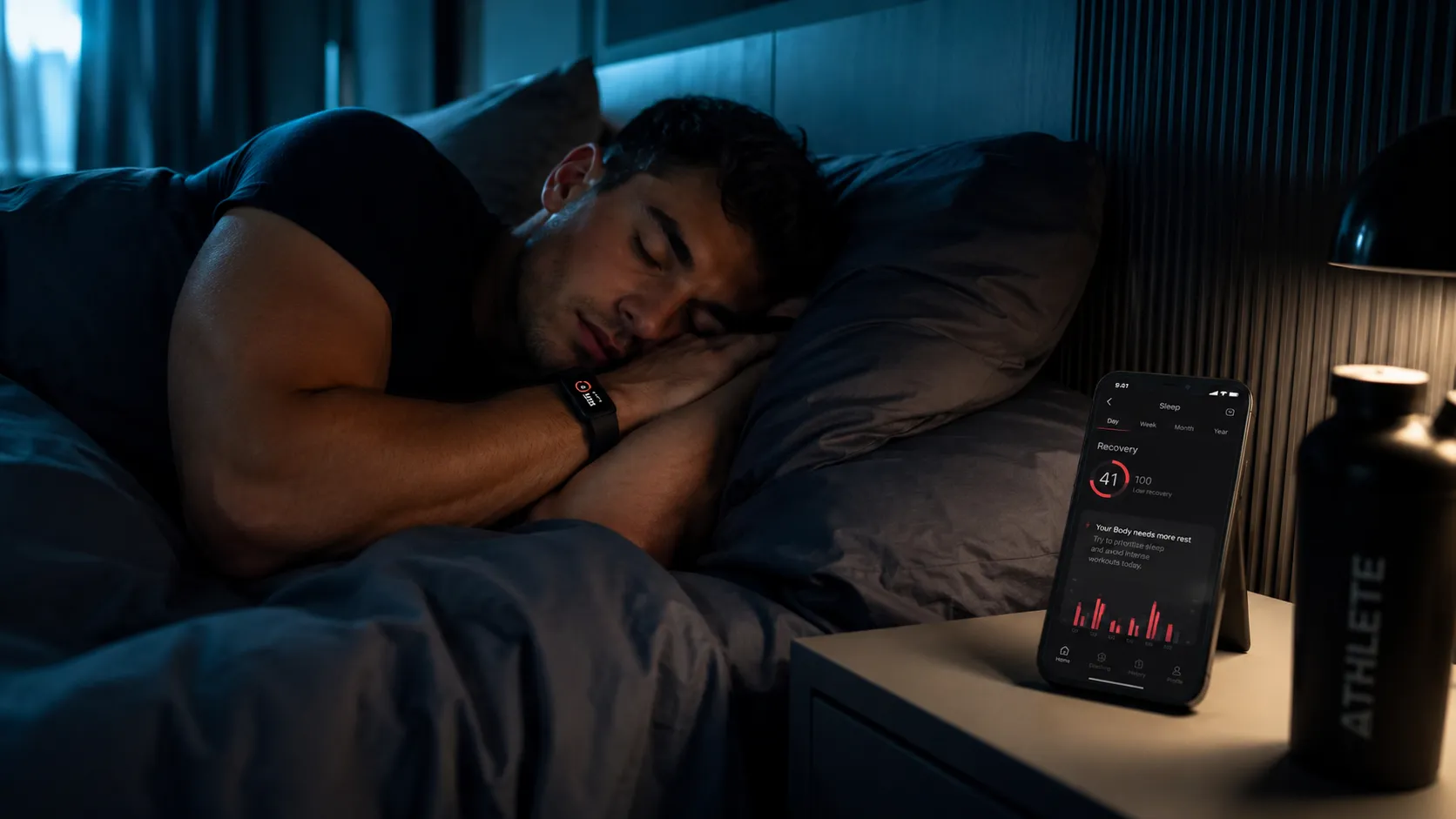
Wearables like Whoop, Oura, and the Apple Watch can estimate sleep stages, sleep duration, and recovery scores, and many lifters find this data genuinely useful for spotting patterns — like realizing that a late workout consistently pushes bedtime back by an hour, or that a single glass of wine noticeably reduces deep sleep.
That said, sleep trackers aren’t required to fix poor sleep and muscle growth issues. The core habits — a consistent schedule, a dark and cool room, limited late caffeine, and a simple wind-down routine — work whether or not you’re wearing a device. A tracker is most useful as a feedback tool once those basics are already in place, helping you fine-tune details rather than replacing the fundamentals altogether.
If you do use one, focus on trends over 2–3 weeks rather than obsessing over a single night’s score. Sleep quality naturally fluctuates, and treating one “bad” reading as a crisis can create the kind of sleep anxiety that ironically makes falling asleep even harder.
FAQ About Poor Sleep and Muscle Growth
How many hours of sleep do I need to build muscle?
Most people need at least 7–9 hours per night. Serious strength and hypertrophy training often benefits from the higher end of that range, especially during intense training blocks.
Can one bad night of sleep ruin my gains?
No single night will ruin your progress, but chronic poor sleep over weeks and months has a measurable negative impact on strength, recovery, and hormone balance.
Does poor sleep affect fat loss as well as muscle growth?
Yes. Poor sleep disrupts hunger hormones, increases cravings, and can make fat loss significantly harder even when diet and training stay consistent, since a tired, under-recovered body tends to hold onto fat as a stress response.
Is it better to sleep more or train harder if I’m short on time?
If you’re already training consistently, extra sleep often provides more return on investment than an additional hard session, since recovery is what allows training adaptations to actually happen.
Can naps make up for poor nighttime sleep?
Short naps (20–30 minutes) can help with alertness, but they don’t fully replace the deep sleep stages needed for hormone release and muscle repair. A nap is a useful patch for one bad night, not a sustainable substitute for consistent nighttime sleep over weeks and months.
Does poor sleep affect beginners and advanced lifters differently?
Advanced lifters, who are closer to their genetic ceiling, tend to be more sensitive to poor sleep since they have less margin for error in recovery.
What’s the fastest way to know if sleep is my limiting factor?
Track both your sleep and your workout log for 2–3 weeks. If poor sleep nights consistently line up with weaker workouts or stalled lifts, sleep is very likely the bottleneck.
Does alcohol affect the connection between poor sleep and muscle growth?
Yes, more than most people realize. Alcohol can help you fall asleep faster but significantly reduces deep and REM sleep, which are exactly the stages most responsible for growth hormone release and muscle repair. Even one or two drinks close to bedtime can measurably reduce sleep quality on a tracker.
Final Thoughts on Poor Sleep and Muscle Growth
Poor sleep and muscle growth are far more connected than most training advice admits. You can have the perfect program and diet, but without enough quality sleep, your body simply doesn’t have the resources or hormonal environment to turn that training into real results.
Start tonight: pick one change from this list — an earlier bedtime, no screens before bed, or cutting afternoon caffeine — and track how your next week of workouts feels compared to before. Give it two full weeks before judging the results; sleep debt doesn’t clear overnight, and neither does its effect on your training. Small, boring consistency in the bedroom often ends up mattering just as much as anything you do in the gym.