Note: This article on gym performance tracking contains affiliate links. If you make a purchase through these links, The Iron Nutrition may receive a small commission at no additional cost to you. We only recommend products that we’ve tested and trust to help improve our performance.
Table of Contents
Introduction
Gym performance tracking is the difference between feeling like you’re improving and actually knowing it. You’ve been going to the gym for months. Your shirts fit a little differently, you feel stronger — but when someone asks “how much progress have you made?”, you shrug.
That’s the problem with training without gym performance tracking: you can feel like you’re improving, but you can’t prove it, and you can’t fine-tune what you don’t measure. Most people who “stop seeing results” haven’t actually stalled — they’ve simply lost sight of the data that would show them exactly what’s changing.
The good news? You don’t need fancy equipment, a personal coach, or a complicated spreadsheet to start gym performance tracking. Below are 7 practical, science-backed ways to measure your gains — so you always know exactly where you stand, and exactly what to change when progress slows down.
Why Gym Performance Tracking Matters
Gym performance tracking isn’t about obsessing over numbers or turning your workouts into a math exercise. It’s about removing guesswork from your training so every session has a purpose. When you consistently track performance, you can:
- Spot plateaus early, before they turn into months-long ruts that kill motivation
- Know exactly when to increase weight, reps, sets, or overall training intensity
- Stay motivated by seeing real, undeniable progress instead of relying on how you “feel” that day
- Adjust your program based on actual data, not guesswork or gym-bro advice
- Communicate more effectively with a coach or trainer, since you’ll have real numbers to share
- Avoid overtraining by noticing warning signs — like stalled lifts or poor sleep — before they cause an injury
In short, gym performance tracking turns training from a routine you hope is working into a process you can actually verify. Now let’s get into the 7 methods that make this possible.
1. Keep a Workout Log
This is the foundation of all gym performance tracking. Write down — on paper or in an app — the exercise, weight, sets, and reps for every single session.
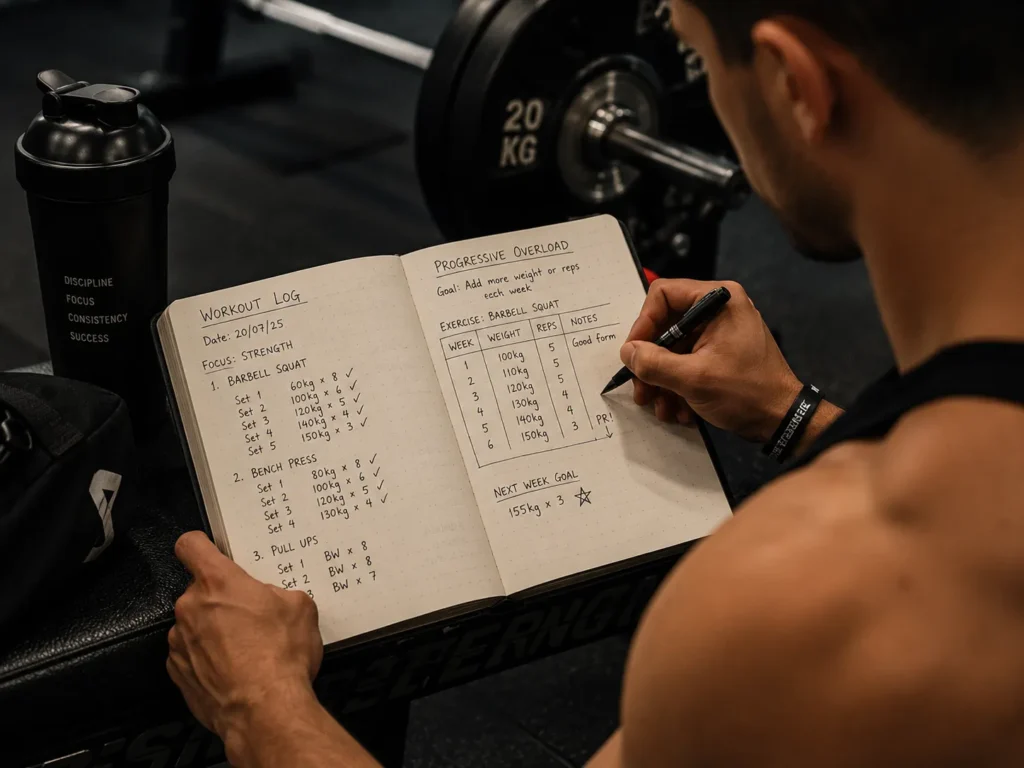
Why it works: if you don’t know what you lifted last week, you have no way of knowing if you’re improving this week. A workout log turns vague memories (“I think I did around 60kg?”) into hard data you can act on.
How to do it well:
- Log immediately after each set, not from memory at the end of the workout
- Include how the set felt (easy, moderate, close to failure) alongside the numbers
- Review your log weekly to spot trends, not just individual sessions
Tip: Use apps like Strong, Hevy, or even a simple spreadsheet — the tool matters far less than the consistency of actually using it every workout.
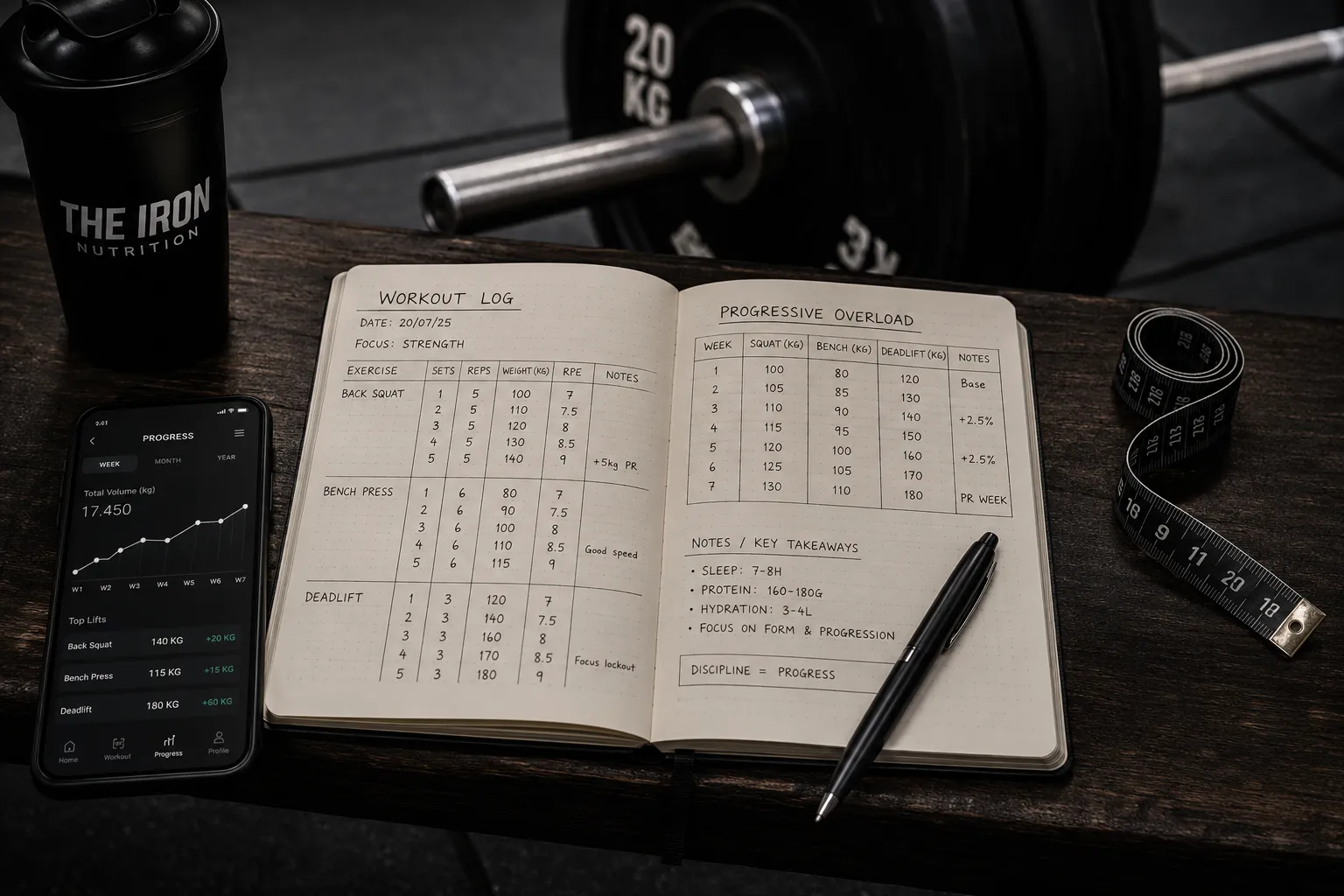
2. Track Progressive Overload
Progressive overload means gradually increasing the demand on your muscles over time — through more weight, more reps, more sets, or less rest between sets. It’s the single most important driver of long-term strength and muscle gains.
Track it by asking each week: “Did I lift more weight, do more reps, or rest less than last time?”
If the answer is consistently “no” for two or three weeks in a row, that’s your signal to adjust your training — whether that means changing your rep range, improving your sleep, or simply eating more to fuel recovery.
Common mistake: many people increase weight too fast and sacrifice form. Progressive overload should feel like a gradual climb, not a sudden jump. For deeper scientific insights on how mechanical tension drives adaptation, you can read the research published by the National Institutes of Health.
3. Take Body Measurements
The scale doesn’t tell the whole story — especially if you’re building muscle and losing fat at the same time, which can leave your weight almost unchanged while your body composition changes dramatically.
Measure your:
- Waist, chest, arms, and thighs (use a soft tape measure, always at the same spot)
- Body weight, at the same time of day and under the same conditions
- Body fat percentage, using calipers, a smart scale, or a DEXA scan if available
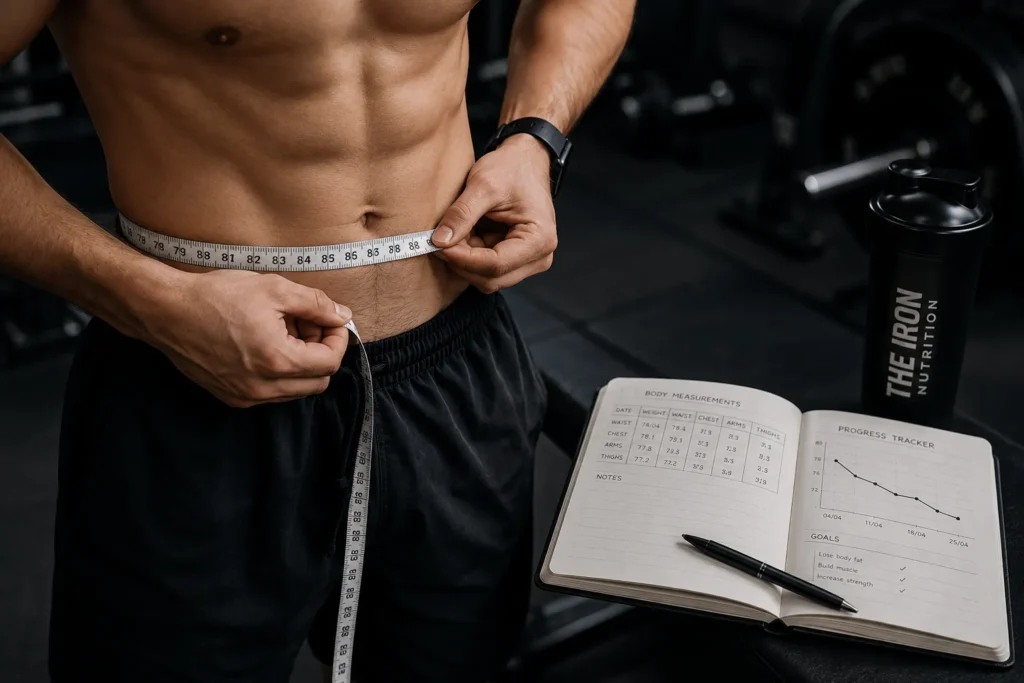
Do this every 2–4 weeks, not daily. Daily fluctuations from water retention, food intake, or hormones are noise, not a real signal of progress.
4. Take Progress Photos
Numbers sometimes lie; photos rarely do. Take photos every 4 weeks in the same lighting, pose, and clothing, ideally in the morning before eating.
Why it works: visual changes often show up before the scale or tape measure catches them — especially shifts in body composition like increased muscle definition or reduced belly fat.
Tip: Keep these photos in a dedicated folder with dates, so you can quickly compare month over month instead of relying on memory.
5. Track Strength Benchmarks (PRs)
Personal records (PRs) are one of the clearest signs of real strength gains. Pick 3–5 key lifts — squat, deadlift, bench press, overhead press, pull-ups — and log your PRs on a monthly basis.
Tip: You don’t need to max out every week, which carries injury risk and adds unnecessary fatigue. Even tracking your heaviest set of 5 reps (your “5RM”) gives you a reliable, safer strength benchmark over time.
Seeing your squat go from a 5-rep max of 80kg to 100kg over a few months is concrete, undeniable proof that your training is working. To ensure your nutrition supports these strength milestones, check out our guide on Nutrient Timing.
6. Monitor Recovery and Sleep
Performance isn’t only built in the gym — it’s built in recovery. Poor sleep and unmanaged stress directly sabotage strength gains, fat loss, and even motivation to train in the first place.
Track:
- Hours of sleep per night, aiming for consistency more than a “perfect” number
- Resting heart rate (many wearables track this automatically overnight)
- Overall energy levels and mood before workouts, on a simple 1–5 scale
If your numbers are stagnant despite consistent training and good nutrition, recovery is often the missing piece of the puzzle — not your workout program itself.
7. Use Apps and Wearables
Modern tools make gym performance tracking effortless. Fitness apps and wearables — Apple Watch, Whoop, Fitbit, Garmin — can automatically track:
- Workout volume and heart rate zones during training
- Calories burned throughout the day
- Sleep quality and sleep stages
- Recovery scores based on heart rate variability
These tools won’t replace the fundamentals above, but they add an extra layer of precision — especially for spotting long-term trends that would be hard to notice manually.
Common Mistakes That Undermine Gym Performance Tracking
Even with the best intentions, a few habits can quietly sabotage your results:
- Tracking too many metrics at once. Trying to log everything from day one leads to burnout. Start with 2–3 methods and add more later.
- Checking the scale daily. This creates unnecessary stress and hides the real trend behind daily noise.
- Comparing your data to someone else’s. Your baseline, genetics, and training history are unique — progress should always be measured against your own past self.
- Giving up after a plateau. A stall of 1–2 weeks is normal. Consistent tracking helps you tell the difference between a temporary plateau and a real problem.
How Often Should You Track Your Gym Performance?
There’s no single right answer, but a simple rhythm works well for most people:
- Every workout: log your sets, reps, and weight
- Weekly: review your training log for progressive overload trends
- Every 2–4 weeks: take body measurements and progress photos
- Monthly: re-test your strength benchmarks (PRs)
This rhythm keeps gym performance tracking simple and sustainable, without turning every day into a data-entry chore.
Final Thoughts on Gym Performance Tracking
You don’t need to track everything, every day. Pick 2–3 methods from this list that fit your goals and stick with them consistently. Over weeks and months, that data becomes your best coach — showing you exactly what’s working, what needs to change, and how far you’ve actually come.
Start today: log your next workout, take a “before” photo, and check back in 4 weeks. Your future self will thank you.
FAQ About Gym Performance Tracking
How long does it take to see results from gym performance tracking?
Most people notice trends in their data within 2–4 weeks, but real, visible changes in strength or body composition usually take 6–8 weeks of consistent training and tracking.
What’s the best app for gym performance tracking?
Strong and Hevy are popular choices for logging workouts, while Apple Watch, Whoop, or Garmin devices are better for automatically tracking recovery and heart rate data. The best app is the one you’ll actually use consistently.
Do I need to track my weight every day?
No. Daily weigh-ins are affected by water retention, sodium intake, and hormones. Weighing yourself 2–3 times per week, at the same time of day, gives a much more reliable trend.
How many exercises should I track for strength benchmarks?
3–5 key compound lifts — like squat, deadlift, bench press, and pull-ups — are enough to give you a reliable picture of your overall strength progress without overcomplicating your tracking.
Can I track gym performance without any apps or wearables?
Yes. A notebook, a simple spreadsheet, and a tape measure are enough to track everything covered in this guide. Apps and wearables just make the process faster and more automatic.
What should I do if my gym performance tracking shows no progress for weeks?
First, check your recovery: sleep, stress, and nutrition often explain stalled progress more than the training program itself. If everything else looks fine, consider adjusting your training variables — weight, reps, or exercise selection.
Is gym performance tracking only useful for building muscle?
No. The same principles apply to fat loss, general fitness, and even sport-specific performance. Tracking simply makes any goal easier to measure and adjust along the way.