Table of Contents
Introduction
Progressive overload mistakes are one of the biggest reasons lifters plateau for months without realizing why. You’re showing up, you’re putting in effort, but the numbers on the bar simply aren’t moving — and it’s not always obvious what’s going wrong.
The tricky part is that progressive overload mistakes don’t feel like mistakes. You still leave the gym tired, still feel like you had a “good workout,” and still assume progress is happening somewhere in the background. Meanwhile, your muscles have quietly stopped receiving any reason to grow.
Here are 5 clear signs that you’re making progressive overload mistakes, and exactly what to do about each one.
Sign 1: You’ve Lifted the Same Weight for Months
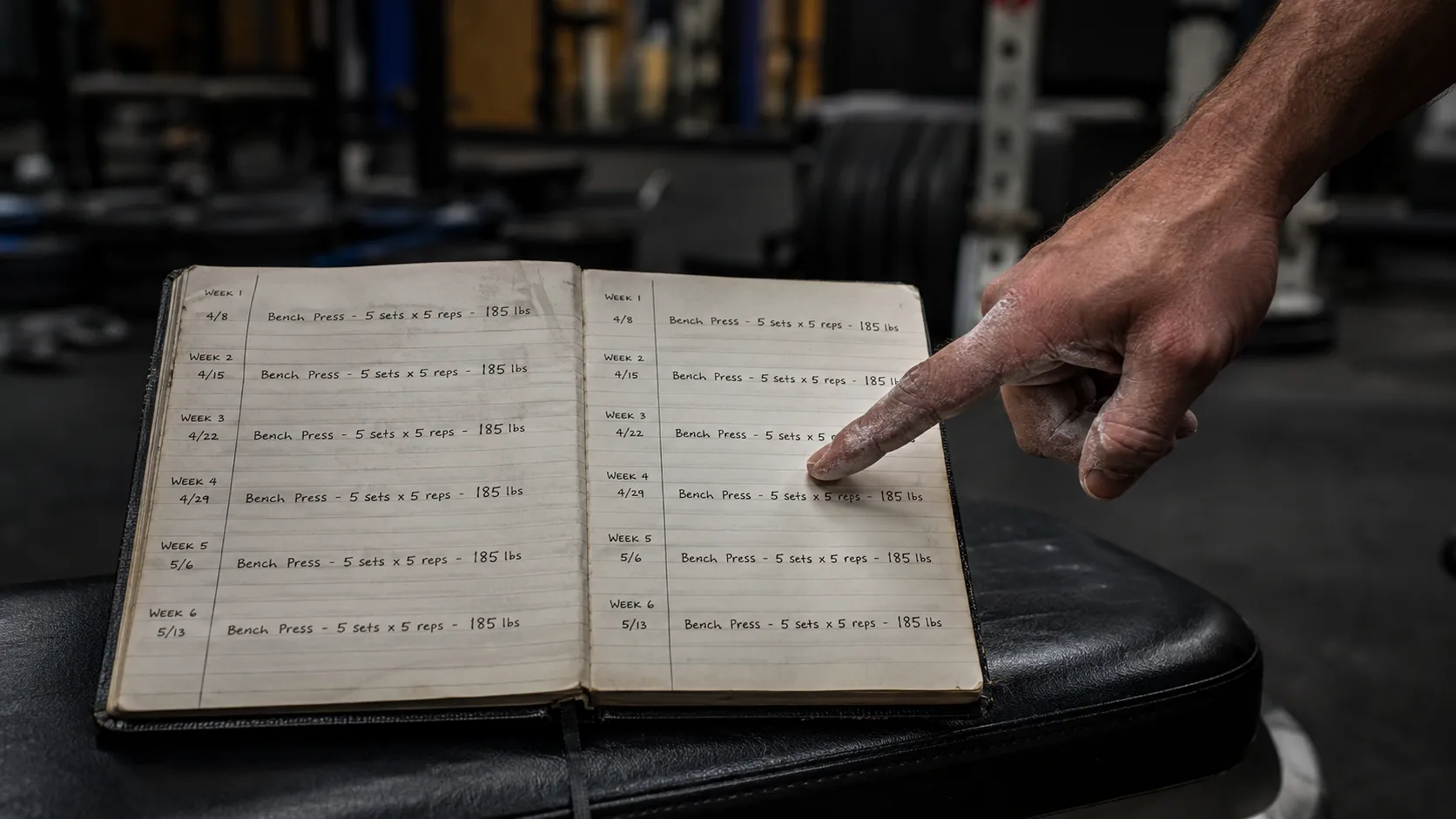
If you check your workout log (or your memory, if you don’t have one) and realize you’ve used the exact same weight, for the exact same reps, for the past 8–12 weeks, this is the clearest sign of a progressive overload mistake.

Why it happens: it’s comfortable. The weight feels manageable, the workout still feels “hard enough,” so there’s no obvious pressure to change anything.
How to fix it: pick one exercise and commit to adding either 1 rep or a small amount of weight next session, even if it feels unnecessary. Small, boring increases are exactly what drive long-term results.
Sign 2: You’re Adding Weight, But Sacrificing Form
This is a subtler version of a progressive overload mistake — you are increasing the number on the bar, but your range of motion is shrinking, your form is breaking down, or you’re using momentum to move the weight.

Why it happens: ego and impatience. Adding weight feels like progress, even when the actual muscle stimulus stays the same or gets worse.
How to fix it: if your form changes noticeably when you add weight, that’s the sign to slow down. True progressive overload should let you keep — or improve — your form while gradually increasing the demand. To ensure your body composition is genuinely improving rather than masking poor movement, you can track changes accurately using the Arboleaf Smart Body Measuring Tape.
Sign 3: You’re Not Keeping Any Kind of Workout Log
This might be the most common progressive overload mistake of all: not tracking anything, so there’s no way to know if you’re actually overloading your muscles or just repeating the same session from memory. For a broader look at scientific principles behind physical adaptation, you can also review research via the National Institutes of Health.
Why it happens: logging feels like extra work, and many lifters assume they’ll “just remember” what they lifted last time.
How to fix it: even a simple note in your phone — exercise, weight, sets, reps — is enough to eliminate this mistake completely. You can’t apply progressive overload consistently if you don’t know what “last time” actually looked like. If you prefer a dedicated physical format to keep yourself accountable, our 12-Week Fitness Tracker & Food Journal makes this effortless.
Sign 4: Your Reps and Sets Never Change, Session After Session
If every single workout looks identical — same weight, same reps, same sets, same rest — for weeks at a time, your training has stopped being progressive. This is a slower, quieter version of a progressive overload mistake that’s easy to miss because everything still looks structured.

Why it happens: following a program rigidly, without adjusting it as you get stronger, is a common trap — especially with beginner programs that don’t account for individual progress.
How to fix it: review your training every 1–2 weeks and ask: “Did anything increase since last time?” If the answer is consistently no, it’s time to add a rep, a set, or a small amount of weight.
Sign 5: You Feel Constantly Sore or Fatigued, But Strength Isn’t Improving
This progressive overload mistake often gets mistaken for “hard training.” You’re exhausted after every session, sore for days, but your actual numbers — weight, reps, sets — haven’t moved in a while.
Why it happens: this usually points to poor recovery rather than poor training. Without enough sleep, food, and rest days, your body can’t adapt to the demands you’re placing on it, no matter how intense your workouts feel.
How to fix it: prioritize recovery for 1–2 weeks — more sleep, more food, maybe a slightly lighter training week — before trying to push the weight further. Overload only works if your body can actually recover from it. To dial in your nutrition so recovery matches your physical demands, review our guide on Nutrient Timing.
How to Avoid Progressive Overload Mistakes Going Forward
The good news is that all 5 of these signs share the same root cause: a lack of tracking and periodic review. If you keep a simple workout log and check it before every session, most progressive overload mistakes disappear almost automatically, because you’ll always know exactly what “more” needs to look like this week.
A simple weekly habit works well: once a week, scan your log and ask which exercises have genuinely progressed and which ones have quietly stalled. That five-minute review is often the difference between a program that keeps working and one that plateaus without anyone noticing.
How These Mistakes Compound Over Time
None of these 5 signs feel dramatic in isolation — that’s exactly why they’re so easy to ignore. A single week of the same weight isn’t a problem. A single session with slightly worse form isn’t either. The real damage comes from letting any of these patterns repeat for months without noticing, because by the time you realize your bench press hasn’t moved, you may have lost 3–4 months of potential progress.
This is also why relying on memory instead of a written log is so risky: memory tends to smooth over stagnation. You remember “training hard,” not the fact that your numbers were identical for six weeks straight. A log removes that blind spot completely, turning a vague feeling of effort into a clear, comparable record you can actually act on.
Frequently Asked Questions About Progressive Overload Mistakes
How do I know if I’m making a progressive overload mistake?
The clearest sign is a training log that shows the same weight, reps, and sets for 4+ weeks in a row on a given exercise, with no adjustment in either direction.
Is lifting heavier every single session a progressive overload mistake?
Not automatically, but trying to add weight every session without enough recovery often leads to form breakdown or injury. Small, consistent increases every 1–2 weeks are usually more sustainable.
Can beginners make progressive overload mistakes too?
Yes, most commonly by following a rigid beginner program without adjusting it as they get stronger, or by not tracking their lifts at all.
Does soreness mean I’m avoiding progressive overload mistakes?
No. Soreness is a poor indicator of progress. You can be very sore without actually increasing weight, reps, or sets — which means no real overload occurred.
What’s the fastest way to fix a progressive overload mistake?
Start logging your workouts immediately, even if it’s just a note on your phone. Most progressive overload mistakes are fixed simply by knowing what you did last time and adjusting from there.
Can too much recovery also be a progressive overload mistake?
Indirectly, yes. If you’re resting so much that you rarely feel challenged during training, you may not be generating enough stimulus to justify progression in the first place.
Should I change my whole program if I spot one of these signs?
Not necessarily. Often you just need to adjust one variable — weight, reps, sets, or rest — on the specific exercises that have stalled, rather than overhauling the entire program.
Final Thoughts on Progressive Overload Mistakes
Progressive overload mistakes are rarely dramatic — they’re usually small, quiet habits that build up over weeks and months: skipping the log, following a program too rigidly, or mistaking soreness for progress. The fix is almost always the same: track your training, review it regularly, and make small, deliberate adjustments instead of hoping progress happens on its own.
Start today: open your last workout log (or start one right now) and check whether anything actually increased compared to your previous session. If not, that’s your sign to make one small change next time — and to keep tracking, so these mistakes never have a chance to quietly pile up again.
1 thought on “Progressive Overload Mistakes: 5 Signs You’re Doing It Wrong”