
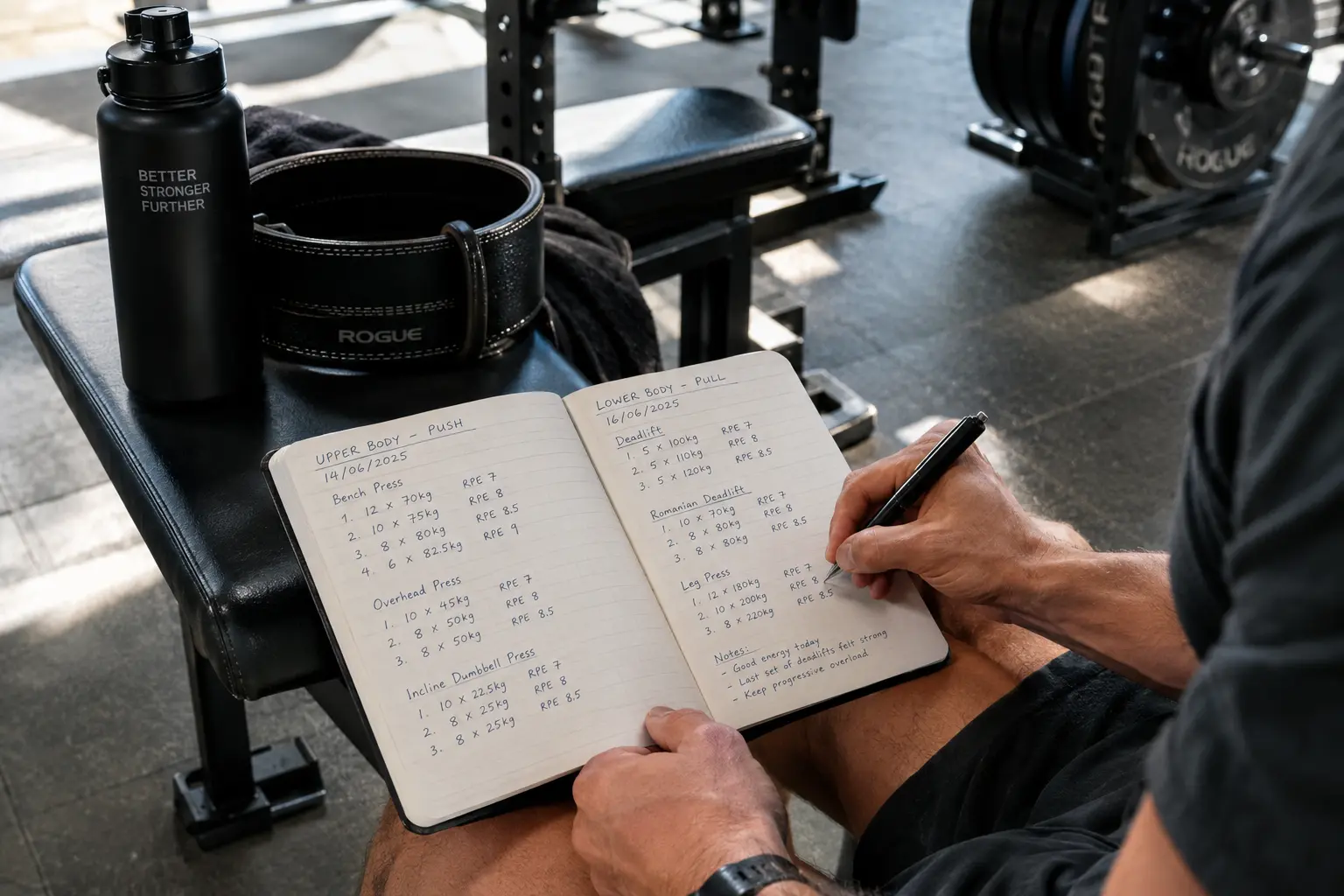
Quick Answer: RPE-based double progression tracking allows natural lifters to drive muscle hypertrophy by manipulating rep ranges and ratings of perceived exertion within a target threshold, completely bypassing the fatigue and injury risks of regular 1RM testing. By logging performance metrics session-to-session in a training diary, athletes can ensure continuous progressive overload using biological feedback rather than rigid, pre-calculated percentages that fail to account daily systemic fatigue.
Table of Contents
Introduction
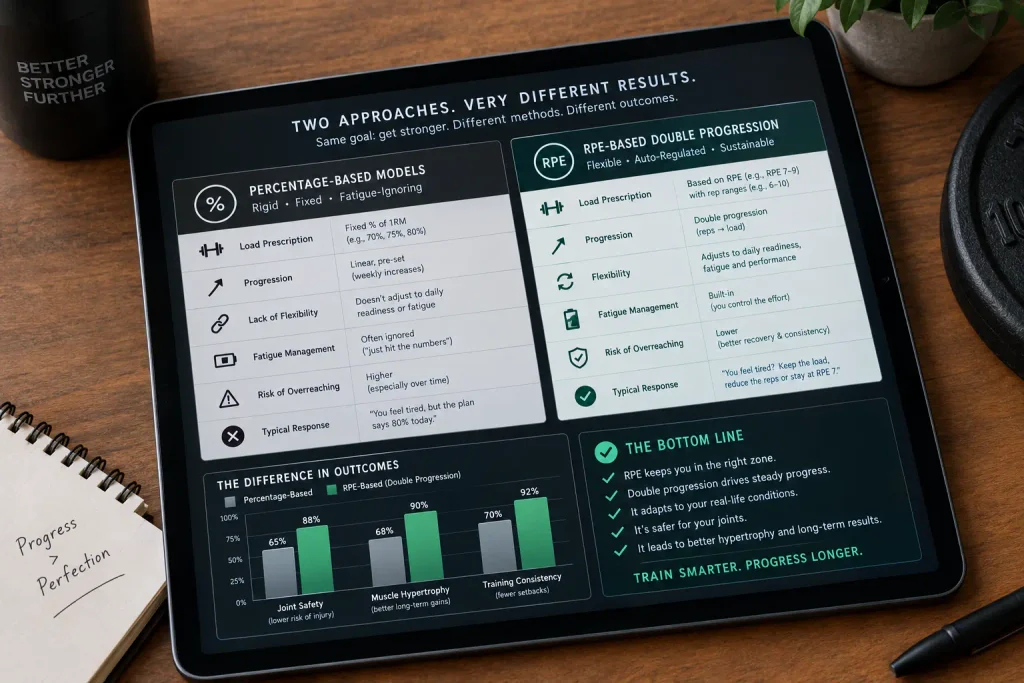
For decades, traditional strength and hypertrophy programs have relied heavily on percentage-based models anchored to a lifter’s One-Repetition Maximum (1RM). You calculate 75%, 80%, or 85% of an arbitrary max tested months ago, plug those numbers into a rigid spreadsheet, and march forward. The fundamental flaw? Your body does not operate like a static mathematical formula. Daily stress, sleep debt, nutritional variations, and cumulative joint fatigue mean that yesterday’s 80% might feel like a crushing 95% today.
For natural athletes prioritizing maximum muscle growth without the systemic burnout of constant maximal testing, percentage models often introduce unnecessary friction. This is where RPE-based double progression tracking changes the paradigm. Instead of chasing fixed numbers derived from an ego-driven max test, you track performance within a dynamic execution bracket. This article breaks down the structural differences between these two methodologies, examines how to implement RPE-based double progression in your workout log, and shares data from a 4-week real-world trial measuring actual hypertrophy outcomes.
Understanding Percentage-Based Models in Hypertrophy
Percentage-based programming derives its lineage directly from powerlifting and weightlifting preparation blocks. Coaches assign specific percentages of an athlete’s tested 1RM to dictate working weights for specific rep ranges.
The Mechanics of Percentage Programming
In a classical percentage framework, a training block might prescribe 4 sets of 6 repetitions at 80% of 1RM. Every single variable—weight on the bar, number of sets, and target reps—is predetermined prior to stepping foot in the gym. The underlying assumption is that tracking progress is straightforward: if you successfully hit all prescribed sets and reps, you add 2.5% to 5% to your base 1RM calculation for the next mesocycle.
Limitations for Natural Bodybuilding
While structured and clean on paper, percentage-based models present distinct structural disadvantages for non-pharmacological hypertrophy trainees:
- Fatigue Fluctuation: Biological performance varies by 5% to 10% daily depending on glycogen stores, hydration, and central nervous system recovery. Forcing a lifter to hit a rigid percentage on a high-fatigue day shifts the stimulus away from hypertrophy and toward unnecessary joint strain.
- 1RM Decay and Distortion: A 1RM test performed four months ago loses relevance rapidly as muscle mass, conditioning, and neurological efficiency shift.
- Testing Trauma: True 1RM testing introduces immense systemic stress and injury risk, diverting recovery resources away from the actual goal of muscle fiber accrual.
To balance your training volume safely around systemic fatigue and learn how to schedule recovery periods effectively, you can read more in our guide on Deload Week: How to Know You Need One Without Any App or Wearable.
The Mechanics of RPE-Based Double Progression Tracking
RPE-based double progression tracking discards fixed percentages entirely, replacing them with a flexible, feedback-driven framework governed by two distinct levers: load and repetitions.
What is Double Progression?
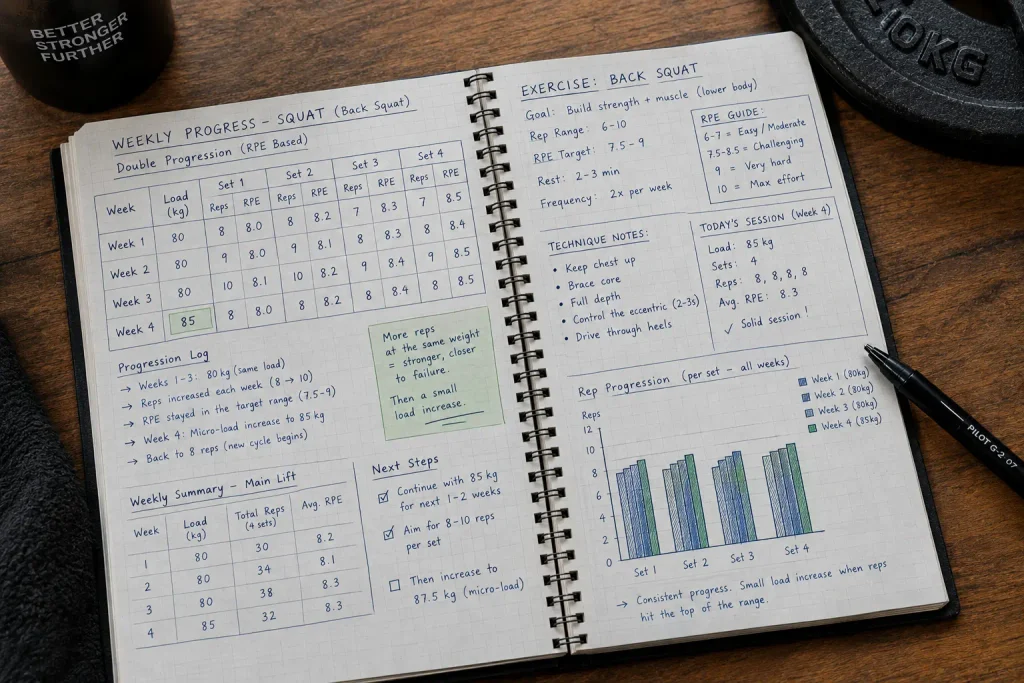
Double progression operates within a predefined rep bracket (for example, 6 to 8 repetitions). Instead of altering the weight every session, you keep the load constant while striving to add repetitions across successive workouts until you hit the top of the bracket (8 reps). Once you successfully achieve the upper limit across all prescribed working sets with proper execution, you increase the load by the smallest possible increment and drop back to the bottom of the bracket (6 reps).
Integrating Rate of Perceived Exertion (RPE)
Adding RPE-based double progression tracking injects an objective measurement of proximity to failure into the equation. Instead of guessing how hard a set was, you assign an RPE or Reps in Reserve (RIR) value based on how many clean repetitions you realistically could have completed if forced to failure.
To ensure your central nervous system is fully primed before entering these high-effort working sets, check out our insights on warm-up experimentation and tracking.
Comparative Breakdown: Percentage vs. RPE Double Progression
| Metric / Feature | Percentage-Based Models | RPE-Based Double Progression |
| Primary Variable | Fixed percentage of historical 1RM | Dynamic adjustment based on current performance and RPE |
| Fatigue Accommodation | Rigid; ignores daily systemic stress fluctuations | High; adapts load to daily biological capacity |
| Testing Requirement | Requires periodic, exhausting 1RM testing | Zero 1RM testing required; relies on logbook data |
| Progression Trigger | Completing macro-cycles or hitting target test days | Hitting the top of a rep bracket at a target RPE |
| Injury Risk | Higher during off-day max attempts | Lower, self-limiting based on daily feedback |
How to Set Up Your Logbook for RPE-Based Double Progression
Implementing this methodology requires a disciplined approach to recording your session data. Follow this step-by-step framework to establish your tracking routine:
Implementing this methodology requires a disciplined approach to recording your session data. Follow this step-by-step framework to establish your tracking routine:
Define Your Rep Brackets: Choose a moderate rep range for each compound movement (e.g., 6–8 reps for heavy presses, 8–12 reps for isolation or secondary movements). Avoid ranges wider than 4 repetitions to maintain consistent mechanical tension.
Establish Baseline Working Weights: Select a weight for your target exercise that allows you to complete the bottom of the rep bracket (e.g., 6 reps) at an RPE of 8. Do not attempt a 1RM test; use your first session to calibrate conservatively.
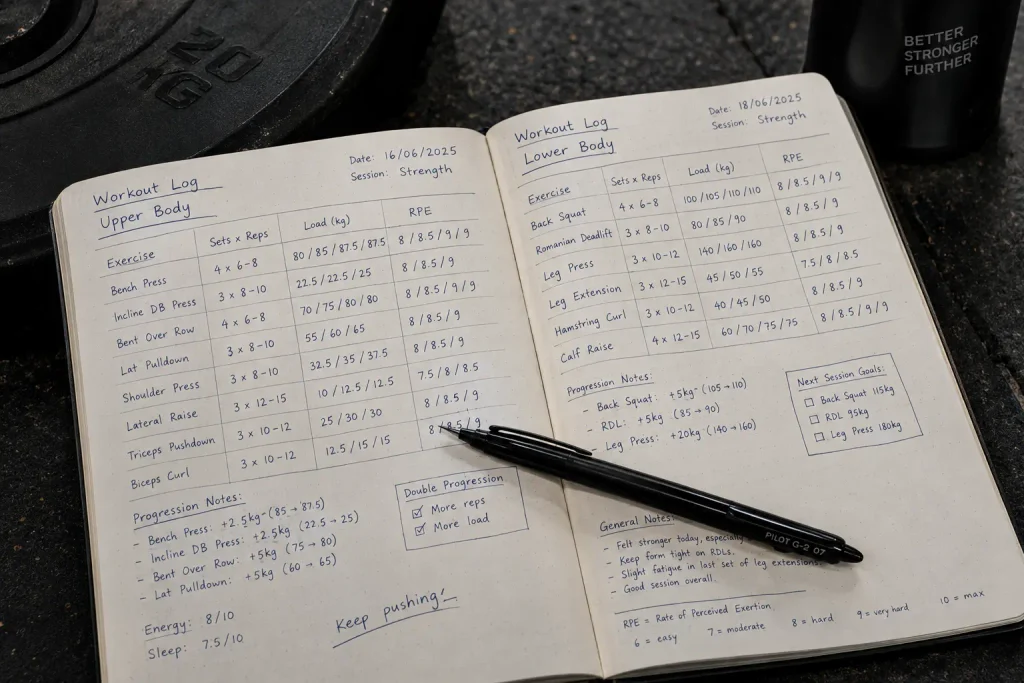
Log Load, Reps, and RPE Consistently: In your training diary, record the exact weight used, the precise rep count achieved on every single working set, and the estimated RPE or RIR immediately following completion.
Execute the Repetition Push: In subsequent workouts, keep the weight identical and focus on accumulating additional repetitions across your working sets until every set reaches the top of the bracket (e.g., hitting 8, 8, 8 reps).
Micro-Load and Reset: Once the upper limit of the rep bracket is successfully achieved across all working sets at or below your target RPE ceiling, increase the load by the smallest possible increment (e.g., 1.25 kg to 2.5 kg) and drop your working reps back down to the bottom of the bracket (6 reps).
My Own Test: 4 Weeks of RPE-Based Double Progression Tracking
To evaluate how RPE-based double progression tracking performs in a real-world hypertrophy block compared to my previous percentage-based routines, I ran a strict 4-week self-experiment on the barbell incline press and bar dips.

Protocol and Baseline Setup
- Duration: 4 weeks (16 total training sessions across an upper/lower split).
- Target Exercise Structure: 3 working sets per exercise within a strict 6–8 rep bracket, targeting a consistent RPE of 8.5 to 9 (1 to 1.5 reps in reserve).
- Tracking Tool: Detailed digital training log recording exact load, completed reps per set, and estimated RPE for every single working set.
- Nutritional Control: Maintained a hyper-caloric surplus of +250 kcal daily with a stable protein intake of 165g, matching previous block parameters to isolate the variable of progression style.
Weekly Data and Observations
During Week 1, establishing baseline weights without a recent 1RM test was surprisingly intuitive. By starting light and pushing set 1 to an estimated RPE 8, I dialed in the correct working weight within a single session.
Week 2 demonstrated the true power of dynamic adjustment. On Tuesday, a poor night of sleep dropped my expected performance. Under an old percentage model, I would have ground through missed reps or strained my joints trying to hit an arbitrary 82.5%. Instead, RPE-based double progression tracking allowed me to keep the exact same weight, accept a drop from 8 reps down to 6 reps on set three while maintaining clean form, and still achieve the exact same hypertrophic stimulus without joint trauma.
By Week 4, both the incline press and dips showed clear upward movement across the board. The incline press weight increased by 5 kg while staying firmly inside the 6–8 rep window at a controlled RPE 9.
What Surprised Me and Limitations
The most surprising outcome was the complete elimination of psychological dread heading into heavy pressing sessions. Without a looming 1RM test date, workout anxiety vanished. However, the limitation of RPE-based double progression tracking is its heavy reliance on absolute honesty. If an athlete lacks the discipline to accurately gauge proximity to failure and pads their logbook with inflated RPE ratings, stagnation creeps in unnoticed. Furthermore, lifters with less than one year of training experience often struggle to accurately identify true technical failure, making RPE fluctuations erratic.
Common Mistakes in RPE and Double Progression Tracking
Avoiding operational errors ensures your logbook data remains a reliable proxy for muscle growth. To avoid committing foundational traps in your training logs, make sure to review our detailed analysis on Progressive Overload Mistakes: 5 Signs You’re Doing It Wrong.
- Moving the Goalposts Prematurely: Bumping up the weight after hitting the top rep range on just one set rather than all prescribed working sets disrupts volume accumulation.
- Collapsing Form to Chase Reps: Allowing execution quality, range of motion, or tempo to degrade just to claim an 8th repetition invalidates the progressive overload metric.
- Ignoring RPE Drift Across Sets: Failing to adjust working weights downward when cumulative fatigue causes RPE to skyrocket prematurely on sets two and three.
- Inconsistent Rest Intervals: Changing rest times between sessions introduces confounding variables that distort whether an RPE increase stems from true hypertrophy or merely better cardiovascular recovery.
To safeguard your progress against chronic fatigue accumulation and protect your logbook metrics, review our breakdown on sleep optimization and systemic recovery tracking.
FAQ
Can beginners use RPE-based double progression tracking effectively?
Beginners can use it, but they often struggle to accurately estimate proximity to failure during their first few months. Pairing the logbook with conservative rep cutoffs (stopping 2–3 reps short of failure) helps build calibration before pushing into high RPE ranges.
How do I handle a session where my strength drops unexpectedly?
Do not force the previous week’s weight if systemic fatigue is high. Keep the weight identical, accept fewer repetitions within your target bracket for that day, and let RPE-based double progression tracking guide your volume organically.
Do I ever need to test my 1RM when using this method?
No. Because hypertrophy relies on mechanical tension and cumulative volume within moderate rep ranges rather than displaying peak single-effort strength, formal 1RM testing is entirely optional and often counterproductive for bodybuilding goals.
What is the ideal rep bracket to use for double progression?
A 6 to 8 or 8 to 12 rep range provides the optimal balance. It offers enough room to track meaningful progress without exposing joints to the extreme mechanical wear of sets under 5 reps or the excessive metabolic burnout of sets exceeding 20 reps.
How do I know when it is time to increase the weight?
You increase the load only when you can complete the maximum number of reps in your designated bracket (e.g., all sets hitting 8 reps) at or below your target RPE ceiling without any breakdown in technique.
Is RPE or RIR better for logging workouts?
They are essentially two sides of the same coin. RPE 9 equals 1 Rep in Reserve (RIR 1). Choose whichever metric feels more intuitive to write down in your training log and stick to it consistently.
What scientific study supports the effectiveness of auto-regulated training?
Clinical research published on PubMed comparing auto-regulated volume and intensity adjustments demonstrates equal or superior strength and hypertrophy outcomes compared to rigid, non-flexible programming models found on PubMed, found that auto-regulated adjustments produced a comparable or superior improvement compared to static models.
Final Thoughts
Rigid percentage models belong on the platform of a powerlifting meet, not in the daily grind of a hyper-focused bodybuilding block. By ditching ego-driven max tests and anchoring your progress to objective biological feedback, you protect your joints, eliminate workout anxiety, and drive consistent, measurable muscle growth. Open your training log today, establish your rep brackets, and let data—not arbitrary numbers—dictate your next move.