Quick answer: Grip strength training means deliberately working your hands and forearms with exercises like dead hangs, farmer’s carries, and plate pinches, using the same progressive overload principles you’d apply to any other lift. Most people can meaningfully improve their grip in 6–8 weeks with just two focused sessions a week.
You’ve probably heard someone mention grip strength lately. Maybe it was a podcast, a longevity doctor, or a study your friend shared. There’s a good reason for that. Grip strength has become one of the most talked-about health metrics of the decade.
But here’s what most articles miss. They explain why grip strength matters. They rarely explain how to actually train it, test it, and track your progress — the way you already do with your squat or your bench press.
That’s what this guide covers.
Table of Contents
What Is Grip Strength Training and Why Does It Matter?
Grip strength is the amount of force your hand and forearm can produce when squeezing an object, and grip strength training means deliberately working to improve that force output over time. Researchers increasingly treat grip strength as a simple, reliable marker of your overall muscular and neurological health.
Large population studies have linked low grip strength to higher risk of cardiovascular disease and earlier death. Grip strength doesn’t cause these outcomes directly. Instead, it reflects something deeper: how well your muscles, nerves, and cardiovascular system are working together as a system.
Think of grip strength as a simple readout, similar to a car’s dashboard warning light. It doesn’t fix the engine. It just tells you something worth paying attention to.
For lifters, grip strength has a second, more immediate benefit. A weak grip limits how much you can deadlift, row, or carry — long before your back or legs give out. Training grip directly removes that ceiling.
What Is a Good Grip Strength for My Age?
A good grip strength for most healthy adults falls between 30–50kg for men and 20–35kg for women, though this varies significantly by age, training history, and hand size. Grip strength typically peaks in your 30s and gradually declines after 40.
Use the table below as a general benchmark, not a strict pass-or-fail test.
| Age Group | Men (average) | Women (average) |
|---|---|---|
| 20–29 | 45–55 kg | 25–35 kg |
| 30–39 | 45–52 kg | 25–33 kg |
| 40–49 | 40–48 kg | 22–30 kg |
| 50–59 | 35–43 kg | 20–27 kg |
| 60+ | 28–38 kg | 16–24 kg |
Values are general population averages measured with a hand dynamometer and can vary by testing method.
If your number sits below these ranges, that’s not a reason to worry. It’s a reason to start training grip strength deliberately, the same way you would any lagging lift.
How to Test Your Grip Strength
You can test your grip strength at home in under five minutes with either a hand dynamometer or a simple dead hang test.
Warm up your hands and forearms. Do 1–2 minutes of wrist circles and light squeezing to avoid a false low reading.
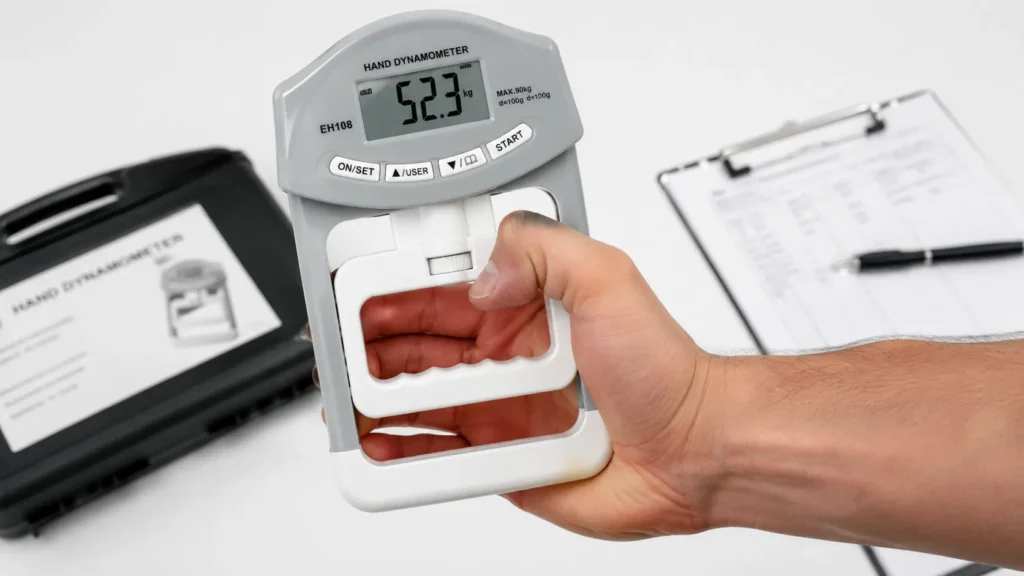
Grip a hand dynamometer at your side, arm relaxed. Squeeze as hard as you can for 3–5 seconds. This is the gold-standard method used in most research studies.
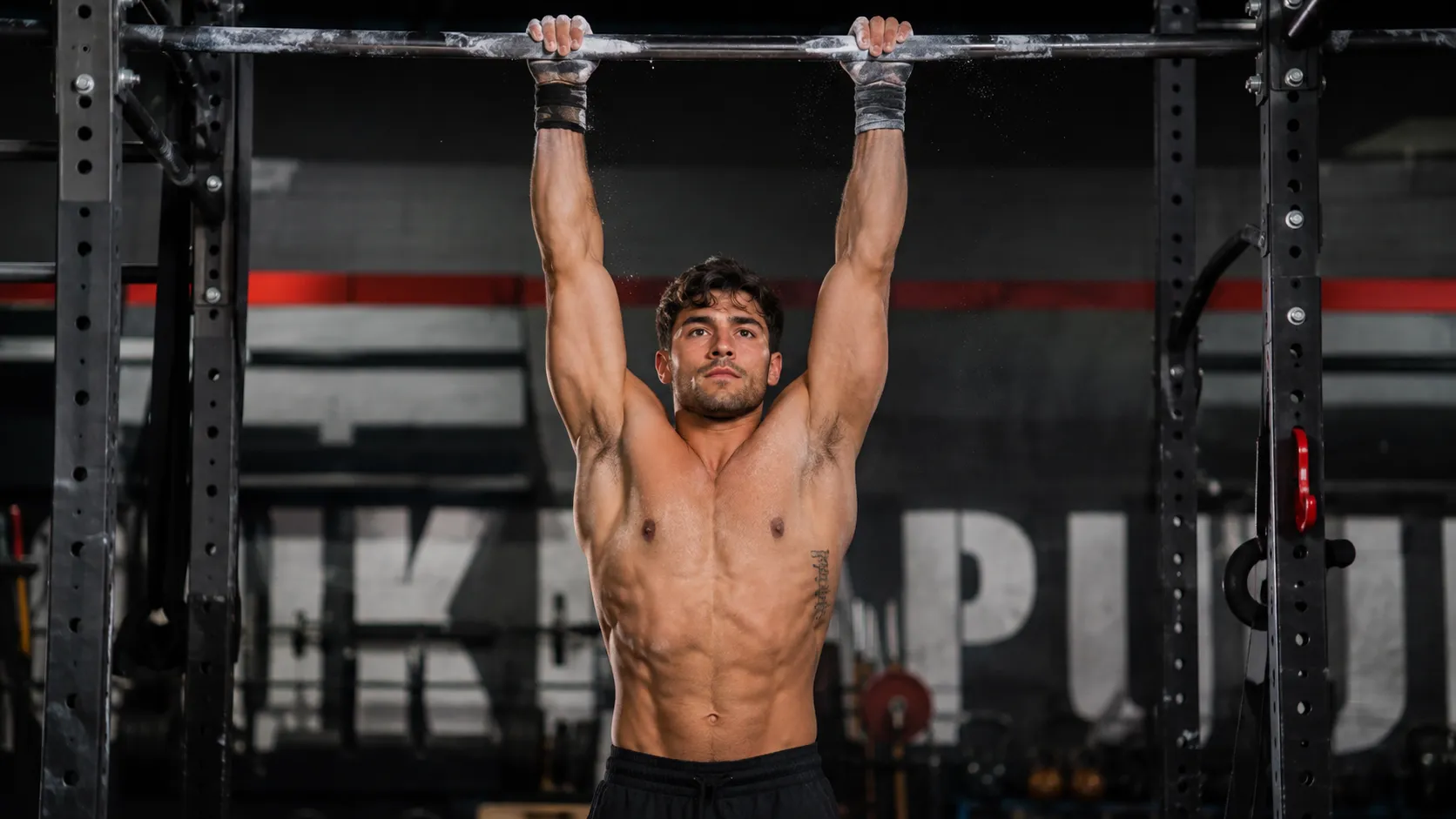
No dynamometer? Use a dead hang instead. Hang from a pull-up bar with a full grip and time how long you can hold on before your hands give out.
Test both hands separately. Rest 60 seconds between attempts, and take the best of three tries per hand.
Record the number. Write down your score, the date, and which method you used, so future tests are comparable.
Most healthy adults without training can dead hang for 20–45 seconds. Anything under 15 seconds is a clear sign your grip is a limiting factor worth addressing.
How to Train Grip Strength Like Any Other Lift
Training grip strength works exactly like training any other muscle group: apply progressive overload, track your numbers, and increase the demand gradually over weeks. Here are four exercises that cover the main types of grip you’ll actually use.
1. Dead Hangs
Hang from a pull-up bar with a full, closed grip and hold for time. This builds what’s called “crush and support” grip — the foundation for almost every other grip exercise.
Start with 3 sets, holding as long as possible with good form, resting 90 seconds between sets. Add 5–10 seconds to your best hang every 1–2 weeks, following the same principle as adding weight to a squat.
2. Farmer’s Carries
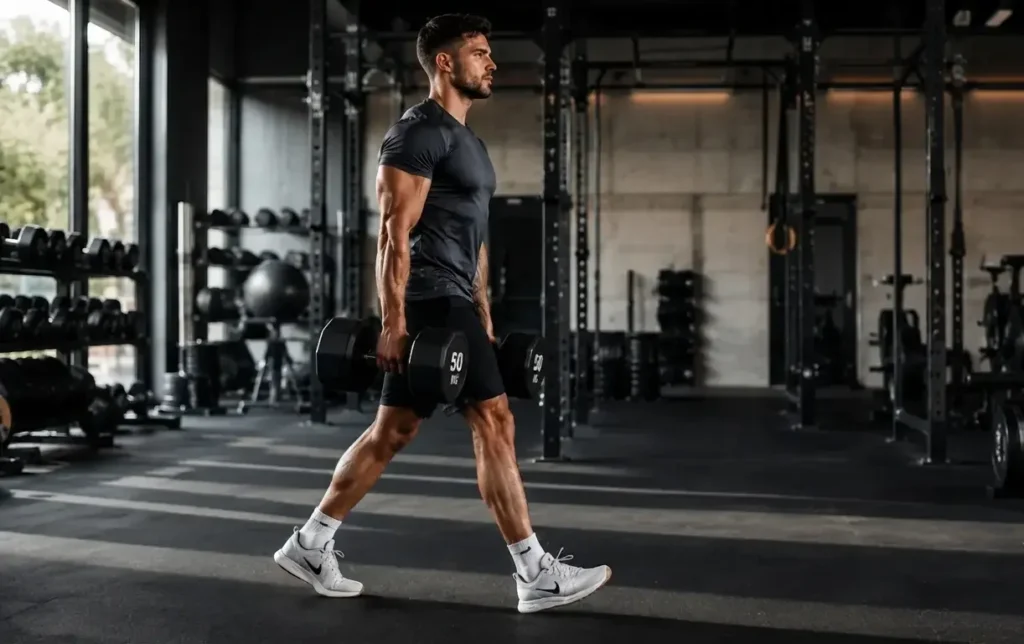
Pick up a heavy dumbbell or kettlebell in each hand and walk for distance or time. This builds “support grip” — the kind you use carrying groceries or luggage.
Start with 3 sets of 30–40 meters, using a weight that challenges your grip before your legs. Increase the weight or the distance, not both at once, to keep the overload progressive and trackable.
3. Plate Pinches
Pinch two weight plates together, smooth sides out, and hold them for time. This targets “pinch grip,” which is notoriously weak in most lifters and rarely trained directly.
Start with light plates (2.5–5kg total) held for 15–20 seconds per set. Progress by adding small amounts of weight rather than time, since pinch grip responds better to load increases.
4. Towel or Fat Grip Work
Wrap a towel around a pull-up bar or dumbbell handle, or use fat grip attachments, and perform your normal exercises with this thicker, harder-to-hold surface. This builds “crush grip” through a wider range of everyday movements.
Add this to exercises you already do — rows, curls, or carries — rather than treating it as a separate workout. The added grip demand comes for free.
How to Track Your Grip Strength Progress Over Time
Track grip strength the same way you’d track any lift in your workout log: record the exercise, the number (time, weight, or dynamometer reading), and the date, then review your trend every 2–4 weeks rather than judging single sessions.
A simple log might look like this:
- Dead hang: starting time, current time, date of last test
- Farmer’s carry: weight used, distance covered, date
- Plate pinch: weight held, time held, date
- Dynamometer score: left hand, right hand, date
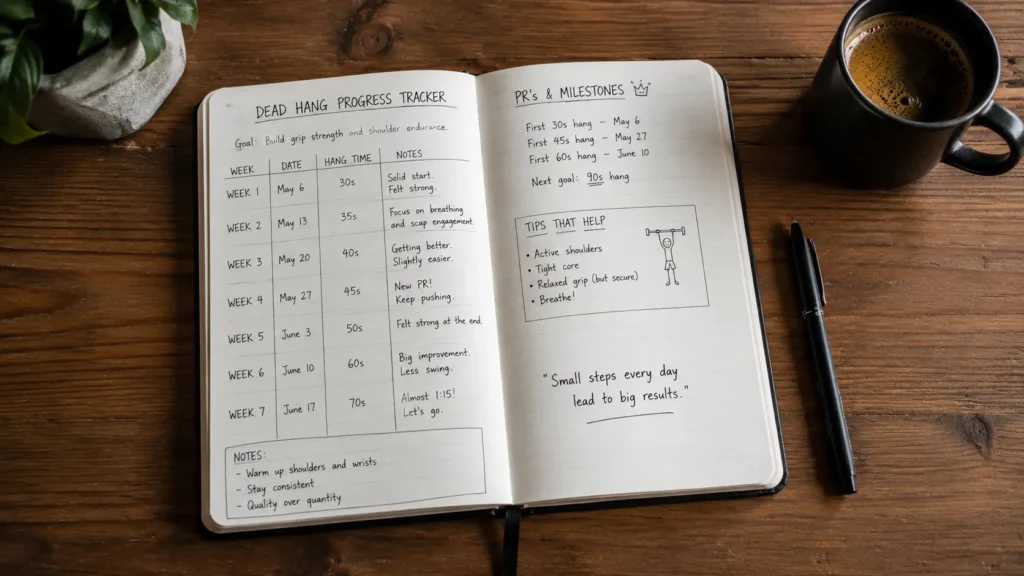
This is theThis is the exact same gym performance tracking approach used for tracking progressive overload on your main lifts — just applied to a muscle group most people never measure at all.
Common Grip Strength Training Mistakes
- Only training crush grip. Dead hangs alone miss pinch grip and support grip, which show up in different real-world tasks like carrying bags or opening jars.
- Training grip to complete failure every session. This slows recovery in your hands and forearms, which then limits your performance on pulling exercises like deadlifts and rows.
- Skipping the warm-up. Cold hands produce a noticeably weaker reading, which can make your test results look worse than your actual strength.
- Comparing your numbers to someone else’s. Hand size, training history, and even your job affect grip strength significantly, so your own trend over time matters far more than any single comparison.
- Never testing at all. Without a baseline number, you can’t tell whether your grip training is actually working or just adding fatigue.
How Often Should You Train Grip Strength?
Two focused grip strength sessions per week, on top of exercises that already challenge your grip (like deadlifts or rows), is enough for most people to see steady progress. Grip muscles recover faster than large muscle groups, but they still need at least 48 hours between hard sessions.
If you’re already training grip indirectly through heavy pulling exercises, one dedicated session a week focused on your weakest grip type (usually pinch grip) is often enough to close the gap.
My Own Experiment: 8 Weeks of Grip Strength Training
I decided to actually test this instead of just writing about it. My starting numbers weren’t impressive: a 22-second dead hang, a farmer’s carry of 24kg per hand for 30 meters, and a pinch grip that could barely hold two 2.5kg plates for 10 seconds. I trained grip strength training twice a week for 8 weeks, using exactly the four exercises in this guide, and logged every session.
By week 4, the dead hang had jumped to 34 seconds — a bigger, faster gain than I expected, and honestly the first sign that this was actually working rather than just being another fitness fad I’d abandon in three weeks. The farmer’s carry felt noticeably easier at the same weight, though the number on my log didn’t move much until week 6, when I finally added 5kg to each hand.
The slowest progress, by far, was pinch grip. It took the full 8 weeks to go from barely holding two plates for 10 seconds to a comfortable 20 seconds, which matches what the research says about pinch grip being the weakest and slowest-improving grip type for most lifters. If I’m honest, I nearly skipped pinch grip work entirely in week 2 because progress felt invisible — glad I didn’t, since by week 8 it had become the exercise I noticed the most real-world difference from, especially carrying grocery bags with thin plastic handles.
My biggest takeaway: the numbers matter less than the habit of testing every 2 weeks. Without that log, I would have sworn the pinch grip work “wasn’t doing anything” around week 3, and quit exactly when it was starting to pay off.
Frequently Asked Questions About Grip Strength Training
How long does it take to improve grip strength?
Most people see measurable improvement in dead hang time or dynamometer score within 6–8 weeks of consistent training, following the same progressive overload timeline as any other muscle group.
Can grip strength training help my other lifts?
Yes. A stronger grip directly raises the ceiling on deadlifts, rows, pull-ups, and farmer’s carries, since grip is often the first thing to fail in these movements, well before your back or legs are actually maxed out.
Do I need special equipment for grip strength training?
No. A pull-up bar for dead hangs and a pair of dumbbells for farmer’s carries cover the two most important grip types. A hand dynamometer is useful for precise tracking but isn’t required to start training.
Is grip strength training safe for beginners?
Yes, when introduced gradually. Start with shorter hang times and lighter carries, then apply the same slow, progressive increases you’d use for any new exercise, rather than testing your absolute limit on day one.
Does grip strength really predict how long I’ll live?
Research shows a consistent statistical association between low grip strength and higher mortality risk in large population studies, though grip strength itself doesn’t cause these outcomes — it reflects broader muscular and cardiovascular health. It’s a useful signal, not a medical diagnosis, so treat any concerning result as a reason to talk to a doctor and start training, not as a prediction.
Can older adults safely do grip strength training?
Yes, and it’s one of the lowest-injury-risk forms of strength training available, since exercises like dead hangs and carries put minimal stress on joints compared to heavier compound lifts.
What’s a realistic grip strength goal for a beginner?
Aim to double your dead hang time or add 20–30% to your farmer’s carry distance within the first 8–10 weeks of consistent training, then reassess and set a new target based on your updated numbers.
Recommended Resource
To dive deeper into the research linking grip strength, longevity, and overall health outcomes, check out the scientific breakdowns on Examine.com.
Final Thoughts on Grip Strength Training
Grip strength training doesn’t need to be complicated or take up much of your week. Two focused sessions, four simple exercises, and a log to track your numbers is genuinely enough to see real progress within two months.
If you’re already tracking your gym performance with a workout log, adding grip strength is as simple as adding one more row to the same spreadsheet or app you already use.
Start today: test your dead hang time right now, write it down, and revisit it in two weeks. That single number is the beginning of your grip strength training log.