

Quick answer: Track your strength comeback by logging your key lifts’ weight, reps, and RPE right before a break starts, then retesting those same lifts in your first 1–2 sessions back. Research shows strength and muscle size hold up far better than most people fear — often with no significant loss for weeks or even months — but the only way to know your personal timeline is to compare your own numbers, not a generic statistic from a headline. This single habit is really the entire method behind learning to track your strength comeback accurately.
Every lifter has felt the same panic: an injury, a trip, a brutal work month, and suddenly two or three weeks pass without a single workout. The internet is full of contradictory claims about what that break actually costs you — some say you’ll lose everything in a week, others say nothing happens for months. Both extremes are wrong for most people, and the only way to know what’s true for you is to track your strength comeback yourself.
Table of Contents
What the Research Actually Shows About Losing Strength (and Why You Should Still Track Your Strength Comeback)
A meta-analysis on resistance training cessation in older adults, published on PMC via the National Institutes of Health, found no significant decrease in muscle size after 12 to 24 weeks of detraining, with a significant decline only appearing after 31 to 52 weeks off. Other systematic reviews examining strength specifically have found similarly reassuring results, with meaningful strength loss typically requiring a much longer break than most lifters assume.
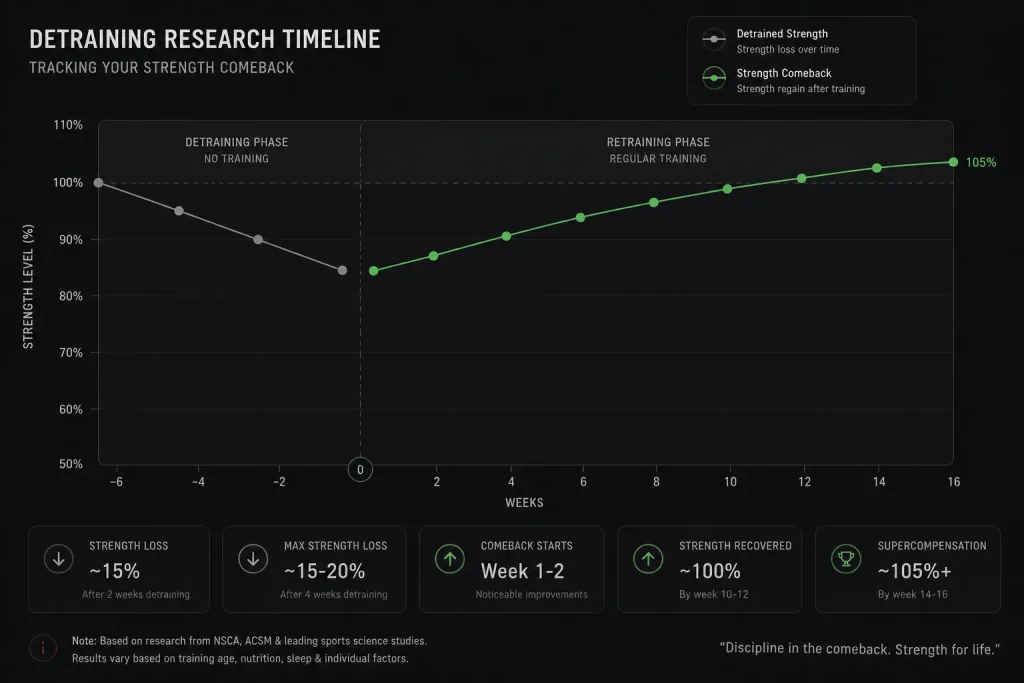
This doesn’t mean a two-week break is entirely free. Some early loss — often driven by neural factors and reduced muscle glycogen rather than actual muscle tissue disappearing — is common and can make your first session back feel harder than expected, even when very little has actually changed at the tissue level.
Why Population Averages Don’t Tell You Your Own Timeline
The research above describes what happens to groups of people, on average, under controlled conditions. Your actual timeline depends on variables no group study can capture: your training age, how the break started (injury versus vacation versus illness), your age, your sleep and nutrition during the break, and even how much incidental activity you kept up without a formal gym session.
This is exactly why the smartest way to track your strength comeback isn’t memorizing a research percentage — it’s comparing your own before-and-after numbers, the same gym performance tracking approach used everywhere else on this blog.
How to Track Your Own Strength Comeback Step by Step
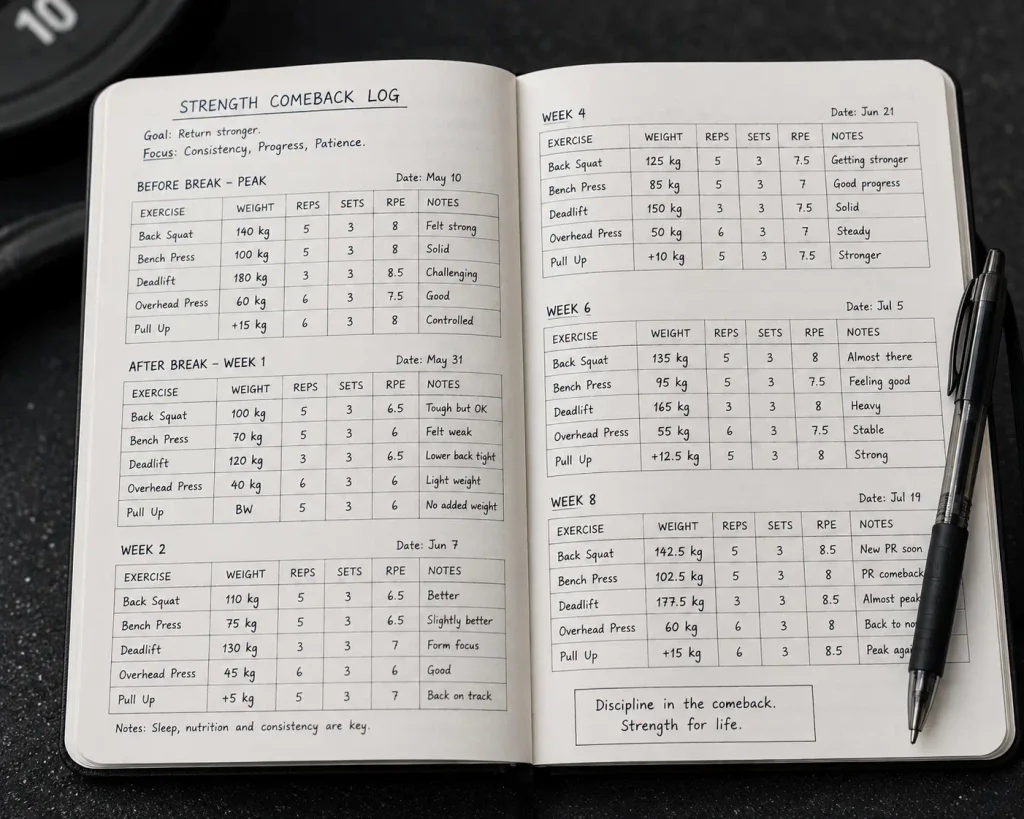
Log your key lifts right before the break starts. Record weight, reps, and RPE for 2–3 main compound movements in your last session or two before stepping away.
Note the reason and expected length of the break, since a planned week off recovers differently than an open-ended injury layoff.
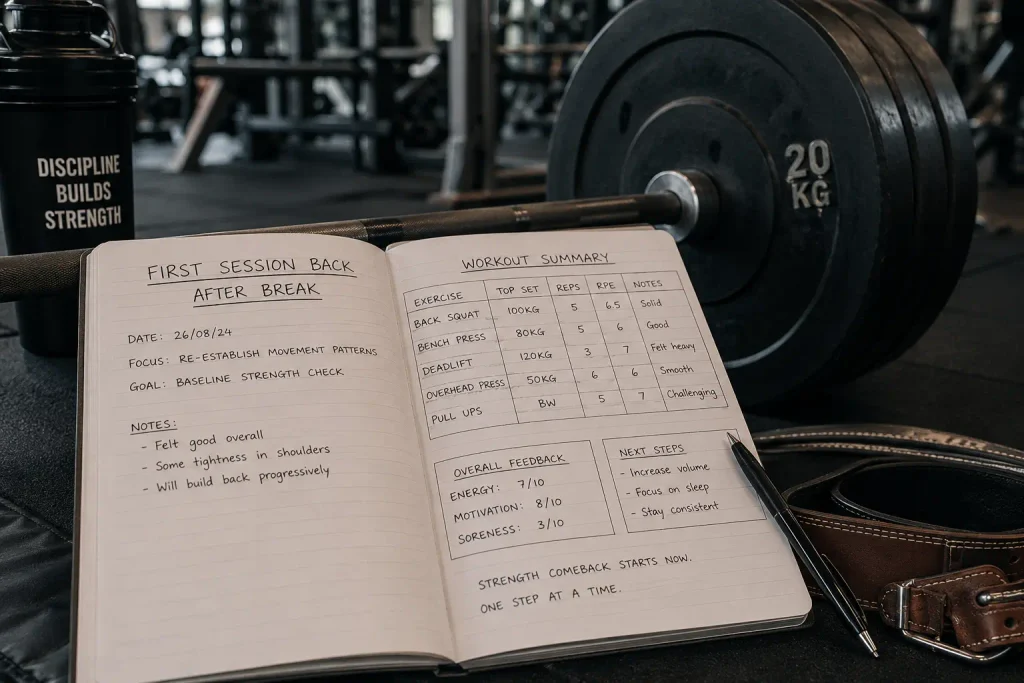
Ease back in rather than testing a max on day one. Use a lighter warm-up set first to gauge how the movement feels before loading up to your pre-break working weight.
Retest your key lifts in your first 1–2 sessions back. Compare the same weight, reps, and RPE directly against your last pre-break entry.
Track your trajectory over the following 2–3 weeks, not just the first session, since most lifters recover pre-break numbers faster than they expect once training resumes consistently.
What to Expect When You Return (While You Track Your Strength Comeback)
Strength typically comes back faster than it was lost, and faster than building it the first time, since your body is re-activating existing neural and structural adaptations rather than building them from scratch. The first session back is often the hardest relative to how little has actually changed — expect your working weight to feel like a higher RPE than your log shows it “should,” even if the weight itself moves fine.
This pattern connects directly to what shows up in deload weeks: a short break followed by a comeback session that feels harder than the numbers justify is common, and it typically resolves within 1–3 sessions rather than indicating a real loss worth worrying about.
My Own Test: Using This Method to Track My Strength Comeback After a 16-Day Forced Break
A bad flu knocked me out of the gym for 16 days — longer than a normal deload, shorter than anything the research flags as concerning. Before getting sick, my squat was sitting at a comfortable RPE 7 for 5 reps. I logged that number and did nothing else training-related until I felt recovered.
My first session back, I deliberately worked up gradually instead of jumping straight to my old working weight. The same 5-rep weight that had been an RPE 7 came in around an 8.5 — noticeably harder, but still completable with the same form. By my third session back, six days later, that same weight was back down to a 7.2, close enough to call it fully recovered.
What surprised me most was how much of that first-session difficulty felt neurological rather than physical — the bar didn’t feel heavier so much as my whole body felt slightly less coordinated moving it, which matches exactly what the research describes about neural factors resolving faster than people expect once training resumes.
Common Mistakes When Tracking Your Strength Comeback
These mistakes are what make people trust a scary internet statistic over their own log when they try to track their strength comeback.
- Testing a heavy single on day one back. Working up gradually gives you a much clearer, safer read on where you actually stand than jumping straight to a near-max attempt.
- Panicking over one hard session. A single tough comeback session is normal and expected — the trend over your first 2–3 sessions back matters far more than any individual one.
- Comparing your break to a scary headline instead of your own log. Viral claims about losing “everything” in a week rarely match the actual research, and definitely don’t match your specific training history.
- Ignoring the reason for the break. An injury-driven layoff often comes with additional factors — pain, compensations, reduced overall activity — that a vacation or short illness doesn’t, and your comeback plan should reflect that difference.
- Rushing back to full volume immediately. Treating your first week back like a mini deload — slightly reduced volume, same frequency — tends to produce a smoother return than resuming your full pre-break program on day one.
How to Use This Data to Plan Future Breaks
This is really the payoff for taking the time to track your strength comeback in the first place — the data becomes more useful every time you use it.
Once you’ve tracked one comeback, you have a personal baseline for how your body specifically responds to time off — information no generic article can give you. If a 16-day break cost you roughly 3 sessions to fully recover, that’s a far more useful planning number for your next vacation or busy period than any population-average statistic.
This same log also helps distinguish a normal comeback dip from something tracked in overtraining signs: if your return-to-baseline takes dramatically longer than your own established pattern, that’s worth paying attention to rather than assuming it’s just “normal detraining.”
Why This Is More Useful Than Memorizing a Research Statistic
It’s tempting to just remember “strength holds up for 12-24 weeks” and stop there, but that number describes a study population, not you specifically. The value of learning to track your strength comeback isn’t the research citation — it’s building a personal record that gets more accurate and more useful every single time you use it.
After even two or three tracked comebacks, you’ll likely notice your own pattern is more consistent than you’d expect: roughly the same number of sessions to recover from a similar length break, a similar RPE bump on day one, a similar timeline back to baseline. That personal pattern becomes far more actionable than any population average, because it’s the actual number for your actual body.
Frequently Asked Questions About Tracking Your Strength Comeback
How long can I take off before I actually lose strength?
Research suggests meaningful strength loss typically requires several weeks to months off, not days, though some early performance dip from neural and glycogen factors can show up much sooner without representing real muscle loss.
Does age affect how fast I lose strength?
Yes. Research on older adults shows detraining effects can appear somewhat sooner and more significantly compared to younger, more heavily trained individuals, making a personal tracking log even more valuable as you age.
Will I lose muscle size and strength at the same rate?
No. Strength — particularly the neurally-driven component — tends to return faster than muscle size changes, which is part of why your first session back often feels harder than your visible muscle mass would suggest it should.
Should I track bodyweight or just my lifts during a break?
Tracking your key lifts before and after matters most for performance, but noting bodyweight changes can help explain unusual results, since significant weight changes during a break can independently affect how a given load feels.
How many sessions should it take to fully recover from a 2-week break?
Based on both research and lifters’ typical self-reported experience, most people return to their pre-break numbers within 2–4 sessions of consistent training, assuming the break wasn’t accompanied by illness or injury requiring longer recovery.
Is it better to ease back in or just resume my normal program?
Easing back in — lighter loads for the first session or two, similar to a mini deload — generally produces a smoother, more accurate read on your actual comeback than jumping straight back into your full pre-break program.
Can tracking my comeback help me plan future time off with less anxiety?
Yes. Once you know your personal recovery pattern from a documented break, future planned time off — a vacation, a busy work stretch — becomes a known quantity instead of a source of guesswork and worry.
Do I need any special tools to track my strength comeback?
No. A simple notebook or the same app or spreadsheet you already use for your regular workout log is enough — the method only requires two entries: your numbers right before the break, and your numbers in the sessions right after it.
Final Thoughts on Tracking Your Strength Comeback
The research is genuinely reassuring: meaningful strength and muscle loss takes far longer than most lifters fear, and what does happen early on is often more neurological than structural. But the only way to actually know your own timeline — rather than borrowing someone else’s — is to track your strength comeback with your own numbers, before the break and after it.
Start today: if you have an upcoming trip, illness, or busy stretch on the horizon, log your key lifts right before it starts. When you return, that single comparison is what it actually means to track your strength comeback — and it will tell you more than any research statistic ever could.