

Note: This article contains affiliate links. If you make a purchase through them, The Iron Nutrition may receive a small commission at no additional cost to you. We only recommend products that we have tested and trust to help improve our performance.
Table of Contents
Introduction
Muscle growth isn’t magic, and it isn’t luck. Hypertrophy — the technical term for the enlargement of muscle fibers — is a biological adaptation your body makes in direct response to mechanical stress. When you place a demand on a muscle that it isn’t accustomed to, your body responds by reinforcing that tissue, making it bigger and more resilient against future stress. That’s prescriptive, clean, and reliable. That’s the entire premise on which every serious physique is built.
Understanding Hypertrophy basics isn’t optional if you want to train with purpose. Too many beginners chase soreness, copy advanced athletes’ routines, or jump between programs every two weeks — and then wonder why their progress stalls. At The Iron Nutrition, we believe in stripping training back to its evidence-based foundation. Before you add volume, drop sets, or complex periodization schemes to your program, you need to understand why muscle grows and which movements give you the most return on your effort. This guide covers exactly that.
The Science of Stimulus: Hypertrophy Basics and Mechanical Tension
At the cellular level, hypertrophy is driven primarily by mechanical tension — the force your muscle fibers generate while contracting against resistance, especially under a stretched, loaded position. When a muscle fiber experiences enough tension, it triggers a cascade of signaling pathways (most notably the mTOR pathway) that switch on muscle protein synthesis. Over time, with adequate recovery and nutrition, this results in measurably larger muscle fibers.
Two other mechanisms — metabolic stress (the “pump”) and muscle damage (micro-tearing of fibers) — also contribute, but research published in peer-reviewed platforms like the National Institutes of Health consistently points to mechanical tension as the primary driver for a natural lifter. When applying these Hypertrophy basics, remember that the foundation of any serious hypertrophy approach rests on one non-negotiable principle:
Progressive Overload
Progressive overload means systematically increasing the demand placed on a muscle over time. This can mean:
- Adding weight to the bar
- Adding an extra rep at the same weight
- Improving the range of motion or tempo
- Adding an extra working set over time
Without progressive overload, your muscles have no reason to adapt. A workout that feels “hard” once will simply become “manageable” as your body adjusts — and manageable stimulus does not build new muscle. For further scientific background on training adaptations and mechanical load, you can explore the Journal of Strength and Conditioning Research. This is the single most important of all the Hypertrophy basics, and it’s the exact metric you should be tracking above all others.
The 5 Essential Movements for Beginners
You don’t need 20 exercises to build a strong foundation. True mastery of Hypertrophy basics comes down to executing a handful of compound lifts that recruit the most muscle mass, allow the heaviest safe loading, and translate directly into strength and size across your entire body. Here are the five non-negotiables.
1. The Squat
The squat is the king of lower-body development, targeting the quadriceps, glutes, and adductors while demanding total-body bracing from the core and upper back.
- Technique focus: Keep your chest up, drive your knees in line with your toes, and descend until your hip crease drops below your knee (or as close as your mobility allows).
- Muscle engagement: Quadriceps (primary), glutes and hamstrings (secondary), erector spinae and core (stabilizers).

2. The Bench Press
The horizontal pressing pattern is unmatched for building the chest, shoulders, and triceps simultaneously.
- Technique focus: Retract your shoulder blades, maintain a slight arch, and lower the bar to your mid-chest under control before pressing back to lockout.
- Muscle engagement: Pectoralis major (primary), anterior deltoids and triceps (secondary).
3. The Deadlift
Arguably the most complete strength movement in existence, the deadlift trains the entire posterior chain in a single hip-hinge pattern.
- Technique focus: Keep the bar close to your shins, brace your core hard, and drive through your heels while keeping your spine neutral throughout the pull.
- Muscle engagement: Hamstrings, glutes, and erector spinae (primary), traps and forearms (secondary).
4. The Overhead Press
Often overlooked in favor of the bench press, the overhead press builds functional shoulder strength and a genuinely three-dimensional upper body.
- Technique focus: Brace your core to prevent excessive lower-back arching, and press the bar in a straight line, tucking your head through at the top.
- Muscle engagement: Deltoids (primary), triceps and upper chest (secondary).
5. The Barbell Row
Every pressing movement needs an equal and opposite pulling movement. The barbell row builds the back thickness that balances your physique and protects your shoulders long-term.
- Technique focus: Hinge at the hips to roughly 45 degrees, keep your spine neutral, and pull the bar toward your lower ribcage, squeezing your shoulder blades together at the top.
- Muscle engagement: Lats and rhomboids (primary), rear deltoids and biceps (secondary).
For guidance on how to fuel these foundational lifts properly while applying core Hypertrophy basics, check out our companion article on Nutrient Timing.
Volume vs. Intensity: Why Less Is More for Beginners
One of the biggest mistakes new lifters make when learning Hypertrophy basics is confusing “more” with “better.” Beginners frequently try to emulate the volume and split routines of advanced bodybuilders — five-day splits, multiple isolation exercises per muscle group, drop sets, and supersets — before their bodies have built the technical proficiency or the recovery capacity to handle it.
The truth is simpler: as a beginner, your neuromuscular system is still learning to recruit muscle fibers efficiently. A handful of hard, well-executed sets on compound lifts will out-perform a high-volume, low-quality program every time.
| Training Variable | Beginner Recommendation | Rationale |
|---|---|---|
| Sets per muscle group/week | 8–12 | Sufficient stimulus without overwhelming recovery capacity |
| Rep Range | 6–12 reps | Balances mechanical tension with technique practice |
| RPE (Rate of Perceived Exertion) | 6–8 | Leaves 2–4 reps in reserve, protecting form and joints |
| Rest Between Sets | 90–120 seconds | Allows adequate recovery for compound lifts |
| Frequency per Muscle Group | 2x per week | Better distributes weekly volume and reinforces technique |
The priority for beginners isn’t maximizing weekly set volume — it’s mastering the mechanics of these five lifts while progressively adding load. Quality repetitions, performed with genuine and controlled effort, will always beat sloppy volume for building both strength and size.
Integrating Tracking: Turning Sets Into Progress
None of the principles above matter if you can’t measure them. Progressive overload is only “progressive” if you know what you did last session — the weight, the reps, and how hard the set actually felt. Without a log, most lifters unconsciously plateau because they simply repeat the same numbers week after week, mistaking familiarity for effort.
At minimum, your training log should capture:
- Exercise, weight, and reps for every working set
- RPE or RIR (Reps in Reserve) to gauge actual intensity
- Rest periods, especially for compound lifts
- Notes on technique breakdowns (missed depth, reduced range of motion, etc.)
This data becomes the roadmap for every future session — telling you precisely when to add weight, when to hold steady, and when a deload is overdue.uture session — telling you precisely when to add weight, when to hold steady, and when a deload is overdue.

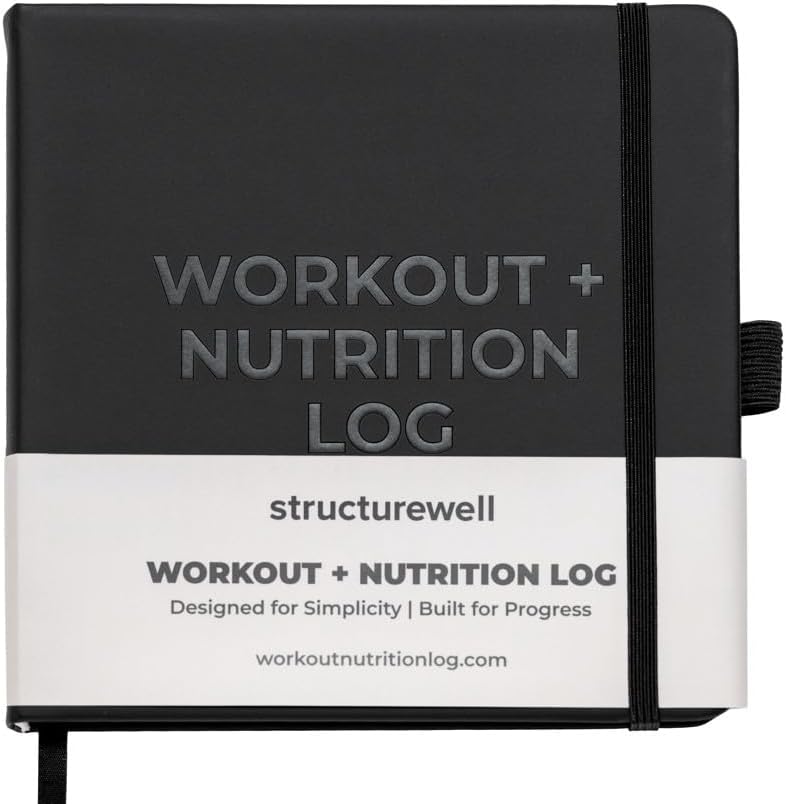 Week Fitness Tracker & Food Journal |  Smart Kitchen Scale with Nutrition Calculator |
|---|---|
| The 12-Week Fitness Tracker & Food Journal is an A5, spiral-bound logbook designed to master progressive overload and daily nutrition. It features a structured 12-week layout combining gym logs—tracking exercises, weights, reps, and RPE—with precise calorie and macro tracking, making it the ultimate tool for data-driven lifters. | The Smart Kitchen Scale & Nutrition Analyzer is a 5000g-capacity digital food scale featuring a large TFT color display and Bluetooth app sync for 999+ foods. It tracks calories and 24 vital nutrients, making it the ultimate tool for precise macro and dietary tracking. |
Conclusion
Hypertrophy is not complicated, but it is precise. It rewards lifters who understand that mechanical tension, applied progressively across a handful of compound movements, is the true engine of muscle growth — not exotic exercise selection or excessive volume. Master the squat, bench press, deadlift, overhead press, and barbell row. Keep your effort honest, your sets tracked, and your overload progressive. That’s the entire foundation of Hypertrophy basics, and implementing these Hypertrophy basics consistently is more than enough to build a lifetime of results.
FAQ
1. How many sets do I actually need per week as a beginner?
Most beginners see excellent results with 8–12 hard sets per muscle group per week, spread across two sessions. More isn’t better if recovery and technique start to suffer.
2. Can I build muscle with only these 5 exercises?
Yes. These five compound lifts collectively train nearly every major muscle group in the body. Isolation exercises can be added later, but they are not required for meaningful early progress.
3. How do I know if I’m using enough weight?
Aim to finish most working sets at an RPE of 6–8 — meaning you could have completed 2–4 more reps with good form. If you could do significantly more, the weight is too light.
4. How long before I see visible hypertrophy results?
Most natural lifters notice measurable strength gains within 4–6 weeks and visible muscle growth within 8–12 weeks of consistent, progressively overloaded training.
5. Should beginners train to failure?
Generally, no. Training close to failure (RPE 8–9) on occasion is fine, but consistently hitting true muscular failure as a beginner increases injury risk and impairs recovery without adding meaningfully more stimulus.