

Note: This article contains affiliate links. If you make a purchase through them, The Iron Nutrition may receive a small commission at no additional cost to you. We only recommend products that we have tested and trust to help improve our performance.
Table of Contents
Introduction
Why Carbohydrate Loading Is a Game-Changer
Carbohydrate loading for endurance athletes is one of the most rigorously researched and powerfully effective nutrition strategies in all of sports science. Done correctly, it can be the difference between hitting the wall at kilometre 30 and crossing the finish line with power still in reserve.
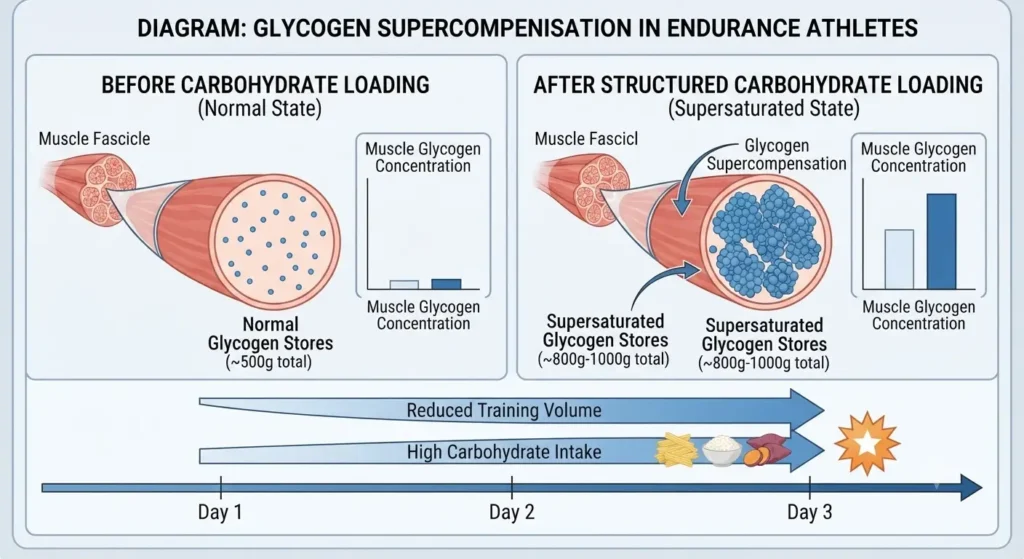
The fundamental principle is deceptively simple: in the days before a major endurance event, you systematically flood your muscles with glycogen — the body’s stored form of glucose — beyond their normal resting capacity. The result is a supersaturated fuel reserve that delays fatigue, preserves pace, and supports sustained high-intensity output long after an unloaded competitor would be forced to slow.
For marathoners, triathletes, road cyclists, and open-water swimmers targeting events lasting 90 minutes or more, mastering this protocol is not optional. It is an essential, evidence-backed competitive tool.
This guide from The Iron Nutrition gives you the complete, science-grounded playbook — seven elite-level strategies, the most common mistakes to avoid, and the exact foods to use. Let’s build your race-week fuel plan.

The Science of Glycogen: How Carbohydrate Loading Works
To use this protocol intelligently, you need to understand what’s happening at the muscle level.
Your skeletal muscles and liver store carbohydrates as glycogen — chains of glucose molecules held ready for rapid mobilisation. The average untrained adult holds roughly 400–500 g of glycogen across these stores. Well-conditioned endurance athletes, through years of high-carbohydrate training, can maintain baseline stores of 500–700 g.
The problem: sustained endurance exercise at moderate-to-high intensity depletes even elite glycogen reserves within 90–120 minutes. When stores drop critically low, the body cannot sustain pace, cognitive function deteriorates, and the cascade of symptoms known as “bonking” or “hitting the wall” begins.
This is precisely where carbohydrate loading for endurance athletes delivers its competitive edge. A peer-reviewed study published in the International Journal of Sport Nutrition and Exercise Metabolism confirmed that a structured carbohydrate loading protocol can elevate muscle glycogen concentrations by 50–100% above baseline, directly extending time to exhaustion and improving performance in events exceeding 90 minutes.
The mechanism is well established. When dietary carbohydrate intake is substantially elevated in the context of reduced training volume, insulin-driven glucose uptake is maximised, and the enzyme glycogen synthase — responsible for building glycogen chains — is upregulated. The result is a muscle cell packed with supraphysiological fuel reserves.
One important physical side-note: every gram of glycogen stored draws approximately 3 g of water into the muscle alongside it. An athlete who successfully loads will often gain 1–2 kg in the days before a race. This is not fat, and it is not cause for alarm. That water is tightly bound to glycogen and represents an additional reservoir of hydration that is released during exercise — a secondary benefit of the protocol.
The 7 Best Strategies for Carbohydrate Loading
Strategy 1: Master the 72-Hour Taper Window
Timing is everything. The modern carbohydrate loading for endurance athletes protocol is initiated three days (72 hours) before race start — not a week out, and not the night before.
During this 72-hour window, you simultaneously reduce training volume by 40–50% (your taper is already happening) and sharply increase carbohydrate intake. This dual shift — less energy expenditure, more carbohydrate substrate — creates the conditions for maximum glycogen supercompensation.
The old-school “depletion-then-load” method, which involved exhaustive exercise in the week before competition to first drain glycogen stores, has been largely retired by modern sports science. Current evidence strongly supports the simplified 3-day high-carbohydrate approach as equally effective and far less physically and psychologically taxing on the athlete.
Strategy 2: Calculate Your Carbohydrate Targets Precisely
Vague guidance like “eat more carbs” will not supercompensate your glycogen stores. Precision is the protocol.
Research-backed daily carbohydrate targets during the loading phase:
| Athlete Profile | Carbohydrate Target |
| Recreational endurance athlete | 8–10 g per kg of bodyweight |
| Competitive / trained athlete | 10–12 g per kg of bodyweight |
| Elite or ultra-endurance athlete | 12–13 g per kg of bodyweight |
For a 70 kg competitive marathon runner, this translates to 700–840 g of carbohydrate per day — a dramatic increase from a typical training-day intake of 350–450 g. Spread this across five to six meals and structured snacks, never attempting to consume it in one or two sittings.
Strategy 3: Choose the Right Carbohydrate Sources
Not all carbohydrates perform equally during a loading phase. The priority is high digestibility, low gastrointestinal burden, and high glycaemic efficiency.
Prioritise these sources:
- White rice, pasta, and noodles (refined, easily digestible)
- Potatoes and sweet potatoes (skin removed pre-load to reduce fibre)
- White sourdough and bagels
- Ripe bananas, dried mango, and Medjool dates
- Rice cakes, pretzels, and low-fat crackers
- Fruit juice and smoothies (liquid carbohydrate to reach volume targets without bulk)
- Sports drinks, gels, and rice-based energy bars during training sessions
Temporarily deprioritise whole grain options during the acute loading phase. Their additional fibre content, while healthy during normal training, slows digestion and increases GI distress risk when consumed in loading-phase volumes.

Strategy 4: Strategically Reduce Fibre and Fat
The single most overlooked element of effective carbohydrate loading for endurance athletes is what you remove from your diet — not just what you add.
Both dietary fat and fibre compete for stomach volume and delay gastric emptying. At normal training intakes this is beneficial — both nutrients support satiety, nutrient absorption, and gut health. In the 72-hour loading window, however, they become obstacles.
Practical adjustments for the loading phase:
- Reduce dietary fat to below 40–50 g per day
- Target fibre intake below 20–25 g per day (down from a typical athlete’s 35–50 g)
- Temporarily remove nuts, seeds, avocado, oils, and high-fat plant proteins from meals
- Replace wholegrains with refined equivalents for this short window only
This is a deliberate, temporary shift — not a long-term dietary recommendation. Restore fibre and fat fully after the event.
Strategy 5: Hydrate Alongside Your Carb Load
Glycogen storage is an inherently hydrating process. But the increased carbohydrate volume and elevated sodium intake during the loading phase also increase your body’s fluid demands significantly.
Target 35–45 ml of fluid per kg of bodyweight per day during your loading window. Include electrolyte-rich beverages — coconut water, sports drinks, or water with electrolyte tablets — to support the sodium-glucose co-transport mechanisms that drive glycogen synthesis.
A practical rule of thumb: your urine should remain pale straw-coloured throughout the entire loading period. Dark urine is a signal to drink more. Clear, colourless urine may indicate over-hydration — which is equally counterproductive.
Strategy 6: Practise in Training — Never Debut on Race Day
This is, arguably, the single most important rule in any carbohydrate loading for endurance athletes protocol: practise it during a training block, at least once, before deploying it on race weekend.
High-volume carbohydrate intake, if unfamiliar to your gut, can trigger bloating, cramping, nausea, and disrupted sleep — none of which you want 48 hours before the most important event of your season.
Select a mock race weekend four to six weeks before your target event. Execute your full loading protocol — volumes, food choices, timing, and hydration — exactly as planned. Use the feedback from that rehearsal to make adjustments. Your race week should never be a nutritional experiment.
Strategy 7: Execute a Flawless Pre-Race Meal
The loading phase culminates in your pre-race breakfast, consumed 2–3 hours before the start gun. This meal serves a dual function: topping up liver glycogen (which depletes overnight during sleep) and providing comfortable, accessible fuel for the opening phase of the race.
The ideal pre-race breakfast formula:
- 70–100 g of carbohydrates from easily digestible, low-fibre sources
- 15–25 g of protein to maintain muscle protein balance
- Minimal fat (below 10–15 g) to preserve gastric emptying speed
- A reliable caffeine source (3–6 mg/kg bodyweight), if tolerated and trained
Proven pre-race meal examples:
- White bagel with light almond butter + banana + sports drink
- White rice with a small serving of scrambled eggs + fruit juice
- Porridge made with oat milk + honey + sliced ripe banana
Avoid all novel foods. Race morning is not the time to experiment.

Common Mistakes to Avoid
Even experienced athletes sabotage their carbohydrate loading for endurance athletes protocol with these avoidable errors:
❌ Loading with high-fibre foods. Whole grain pasta, lentils, and bran-rich cereals are nutritional powerhouses in normal training — but they are the wrong choice during the loading window. Excess fibre at high carbohydrate volumes reliably causes GI distress.
❌ Overloading in a single meal. Attempting to consume an entire day’s carbohydrate target in one sitting overwhelms gastric capacity, spikes and crashes blood glucose, and results in discomfort, bloating, and broken sleep. Distribute intake evenly.
❌ Ignoring the fat cap. Athletes often increase carbohydrate intake without reducing fat, creating a dramatic caloric surplus that causes GI upset and an uncomfortable sense of heaviness.
❌ Skipping the rehearsal. Debuting any new nutritional protocol on race day is a high-risk decision. Always practise first.
❌ Panicking about the weight gain. A 1–2 kg temporary increase in bodyweight during loading is water and glycogen — it is not body fat. It is a sign the protocol is working.
Practical Food Examples for Your Carb Load
Use this guide to build your loading menus across three days:
| Meal | High-Performance Loading Option | Approx. Carbohydrate |
| Breakfast | Large white bagel + banana + 500 ml orange juice + small portion of scrambled egg | ~130 g |
| Mid-Morning | 2 rice cakes + jam + sports drink (500 ml) | ~70 g |
| Lunch | Large bowl of white pasta (200 g dry weight) + light tomato marinara + small side salad (dressing-free) | ~160 g |
| Afternoon Snack | 3 Medjool dates + handful of pretzels + 330 ml isotonic drink | ~80 g |
| Dinner | Large white rice bowl (250 g dry weight) + grilled chicken breast or baked tofu + roasted carrots and courgette | ~150 g |
| Evening Snack | 2 crumpets with honey + banana | ~80 g |
Daily total (approx.): ~670–700 g carbohydrate — appropriate for a 70–75 kg athlete targeting the upper end of the loading range. Adjust portions up or down to match your precise bodyweight target.
For plant-based athletes, swap chicken or eggs for tempeh, tofu, or a pea protein shake. Ensure you are still hitting protein targets of 1.4–1.6 g per kg throughout the loading phase.
Conclusion
Carbohydrate loading for endurance athletes is one of the most evidence-validated and immediately impactful tools in competitive sports nutrition. It is not a trend, a shortcut, or a dietary fad. It is a physiologically grounded protocol, refined over decades of sports science research, that works — when it is planned with precision and executed with discipline.
The seven strategies in this guide give you a complete, tested framework. Know your window. Hit your targets. Choose your sources deliberately. Strip out the fibre and fat. Hydrate intelligently. Rehearse before race day. And finish with a bulletproof pre-race meal.
Implement this protocol correctly, and you will arrive at the start line with muscle glycogen stores that are materially larger than your competitors’. That reservoir is not a comfort — it is a competitive weapon.
Train smart. Load right. Race at your absolute best.
You might also like: “7 Best Steps for Post-Workout Nutrition: Essential Guide”
Published by The Iron Nutrition | Category: Nutrition Guides | Last Updated: June 2026
Found this guide useful? Share it with your training group and explore the full Iron Nutrition content library below.