
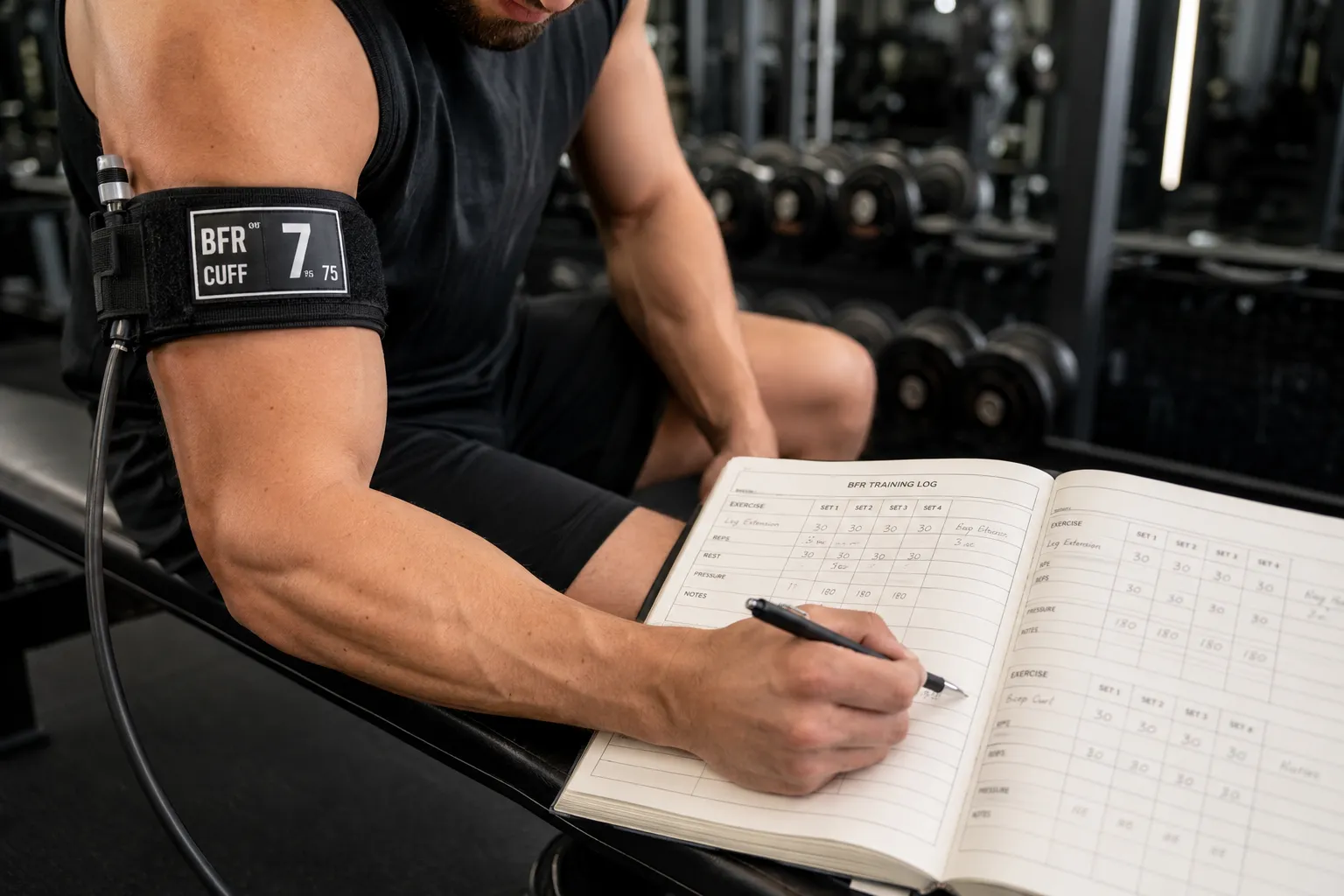
Quick answer: BFR training progress isn’t tracked by adding weight, since the load stays deliberately light. Instead, log cuff pressure, reps completed to near-failure at that fixed load, session RPE, and periodically retest your regular strength without bands to confirm the carryover is real.
You wrap the bands around your arm, do a set of bicep curls with a weight that would normally feel like a warm-up, and your muscles are on fire by rep 15. It works — but next session, what exactly are you supposed to increase? The load is supposed to stay light. This is the exact confusion that makes so many lifters try BFR training for a few weeks and never really know if it’s doing anything.
Índice
Why BFR Training Progress Is So Confusing to Track
BFR training is confusing to track because the entire method depends on keeping the external load low — typically 20–30% of your one-rep max — while a pressure cuff restricts blood flow to create the internal stimulus. The training log habit you’ve built around adding weight to the bar simply doesn’t map onto a method engineered to avoid doing that.
This isn’t a flaw in BFR training itself. It’s a mismatch between the method and the tracking tools most lifters already have. The training log habit built around sobrecarga progressiva — adding weight to the bar over time — simply doesn’t map onto a method engineered to avoid doing that. Once you understand which variables actually change during a well-run BFR program, tracking becomes just as straightforward as it is for any other exercise — it just isn’t the number you’re used to watching.
What Is BFR Training, and What Does the Research Actually Show?
BFR training, also called occlusion or Kaatsu training, uses a pressure cuff or elastic band to partially restrict blood flow to a limb while performing light-load resistance exercise, creating a hypoxic environment that triggers muscle growth similar to much heavier lifting. It was originally developed in Japan and has since been studied extensively in both athletic and rehabilitation settings.
A 2024 systematic review and meta-analysis comparing low-load BFR training directly against traditional heavy-load resistance training, published on PubMed via PMC, found that BFR training produced muscle hypertrophy in a similar range to heavy lifting, but strength gains specifically tended to lag behind traditional heavy training. This is exactly why weight alone is the wrong metric to chase with BFR — the method is genuinely better at building size than at building maximal strength, and tracking it as if it were a normal lift misses what it actually does well.
The Real Variables You Can Progress in BFR Training
1. Cuff Pressure (or Band Tightness)
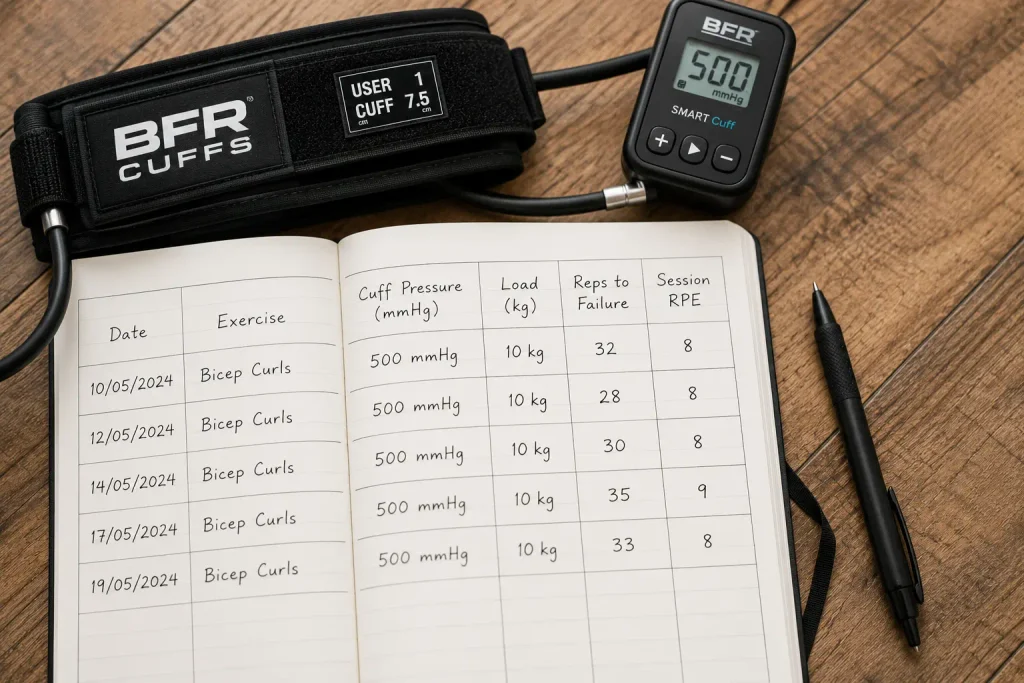
The restriction level itself is a trainable variable. Many practitioners start around 40–50% of estimated limb occlusion pressure and gradually work toward 60–80% as tolerance builds, using a consistent, numbered pressure cuff rather than guessing with an elastic band.
2. Reps to Near-Failure at a Fixed Load
Instead of adding weight, track how many reps you can complete at the same light load before your form breaks down. A jump from 25 reps to near-failure up to 35 reps at an identical weight and pressure is a genuine sign of progress.
3. Session RPE and Recovery Time
BFR sessions typically feel disproportionately hard relative to the light weight involved. Logging your rate of perceived exertion, plus how quickly the burning sensation and soreness resolve afterward, tracks your body’s adaptation to the stimulus over time.
4. Periodic Testing Without the Bands
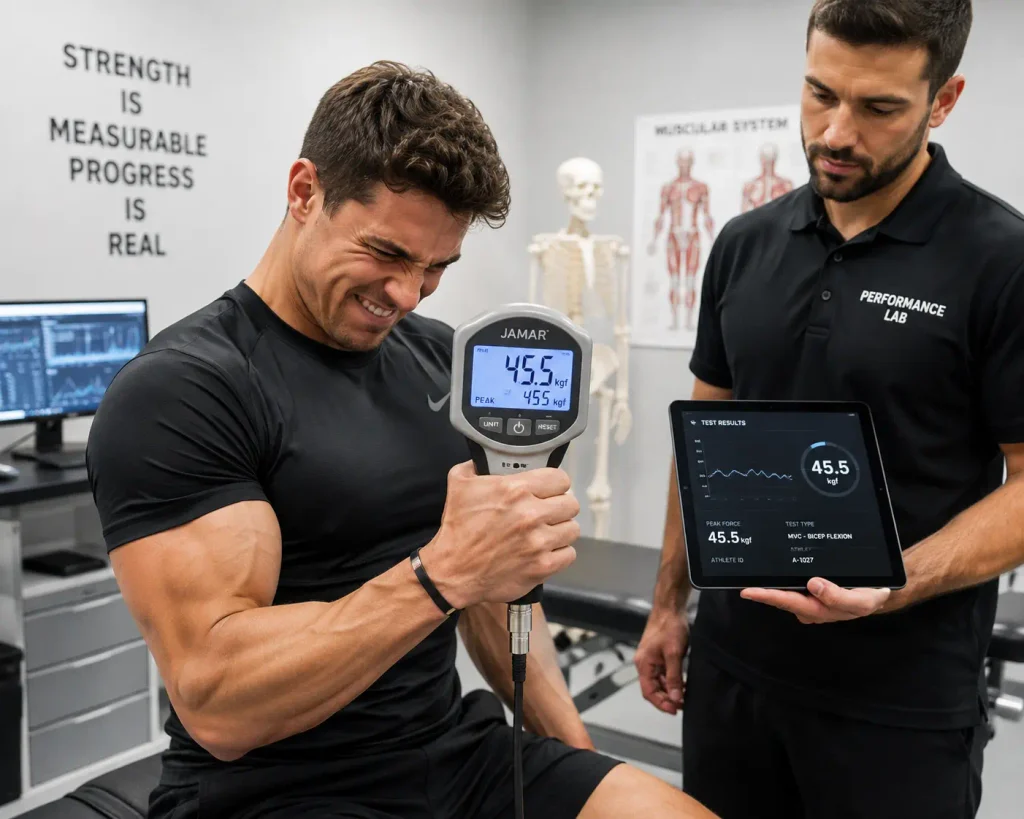
Every 4–6 weeks, test a normal, band-free set of the same exercise at a moderate-to-heavy load and log the result. This is the metric that ultimately matters most — it confirms whether the adaptations from your BFR sessions are actually transferring to real-world strength.
How to Track BFR Training Progress
Track BFR training the same way you’d track any other method in your monitoramento de desempenho na academia log, just with a different set of columns. If you’ve already read our guide on tracking isometric training progress, this will feel familiar — both methods share the same core lesson: when the load can’t be the metric, other variables step in to do that job.
Log the cuff pressure or band setting used that session, in consistent units if your cuff has a gauge.
Record the load and reps completed at that pressure, noting when you reach near-failure.
Rate your session RPE on a 1–10 scale immediately afterward, while the sensation is fresh.
Note recovery time — how long soreness or fatigue from that muscle group lasted.
Retest without bands every 4–6 weeks, logging weight and reps on a normal set of the same movement to confirm real strength carryover.
Common Mistakes When You Track BFR Training Progress
These mistakes are what quietly stall BFR training progress for weeks without anyone noticing, since the sessions still feel hard regardless.
- Trying to increase the external load like a normal lift. This defeats the purpose of BFR training and pushes the pressure and light-load stimulus outside the range the research actually supports.
- Never testing without the bands. Reps-to-failure at a fixed load can plateau even while real strength is improving, so periodic band-free testing is the only way to confirm actual carryover.
- Ignoring cuff pressure consistency. A loose or overly tight cuff changes the entire stimulus session to session, making your rep and RPE data far less comparable over time.
- Using BFR training on every single exercise. It’s most practical and best studied on isolated limb exercises; applying it to every compound lift in a session adds complexity without clear added benefit.
- Skipping the safety basics. BFR training carries real contraindications — a history of blood clots, uncontrolled high blood pressure, and certain vascular conditions all warrant a conversation with a doctor before starting.
My Own Test: 5 Weeks Tracking BFR Training Progress on Bicep Curls
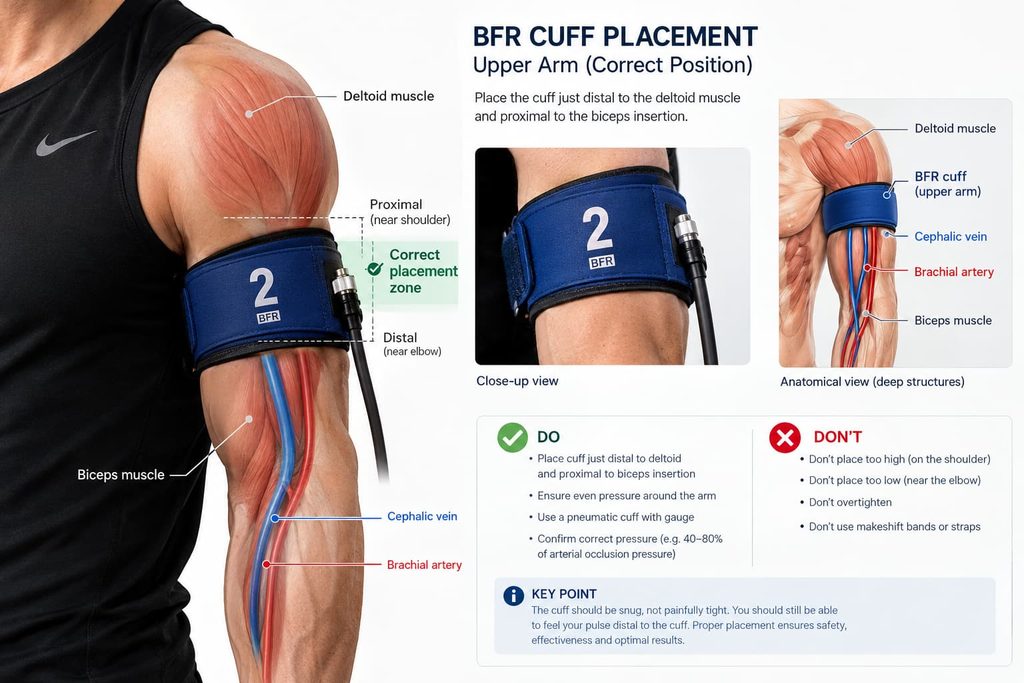
I picked bicep curls as my test exercise, using a weight I’d normally consider embarrassingly light — about 30% of what I’d curl for a working set. Week 1 was humbling: I hit near-failure at 22 reps, arms burning in a way normal light-weight curls never do, and I had genuinely no idea if that number meant anything.
By week 3, the same load and pressure took me to 29 reps before near-failure, a clear jump in the metric I’d chosen to track. But the number that actually convinced me was the band-free test at week 5: my regular working-weight curl, tested without any bands, moved up by 2 reps at the same weight I’d been stuck at for over a month beforehand.
The part that surprised me most was how disconnected the “in-session” burn was from actual soreness. Some of my hardest-feeling BFR sets left me barely sore the next day, while a moderate session once left my forearms sore for three days — a reminder that RPE and recovery time genuinely need to be logged separately, since neither one predicts the other reliably.
How Often Should You Use BFR Training?
Two to three BFR sessions per week per muscle group works well for most lifters, similar to a typical accessory-exercise frequency, with at least 48 hours between sessions targeting the same limb. This is frequent enough to accumulate the metabolic stress the method depends on without adding excessive fatigue to a body part you’re also training with heavier compound lifts elsewhere in your program.
Why Bothering to Track BFR Training Progress Actually Matters
It would be easy to treat BFR training as something you just “feel out” — the burn is intense enough that it seems obvious it’s working. That assumption is exactly what leads people to plateau without noticing, since the burning sensation stays roughly the same intensity session after session even when the underlying stimulus has stopped increasing.
The four variables in this guide take maybe 30 extra seconds per session to log, and that small habit is what separates genuine BFR training progress from spinning your wheels at the same reps-to-failure for months while assuming the burn alone means something is still changing. Once you have a few weeks of data, the pattern — whether you’re actually progressing or plateaued — becomes obvious in a way that “it felt hard” never will.
Frequently Asked Questions About Tracking BFR Training Progress
How do I know if my BFR training is actually working?
The clearest sign is improvement in one of three areas: more reps at the same load and pressure, a shorter recovery time for the same session RPE, or — most convincingly — a measurable increase in your band-free strength test every 4–6 weeks.
What percentage of my max weight should I use for BFR training?
Most research uses roughly 20–30% of your one-rep max for the external load, which is intentionally light enough that the restriction itself, not the weight, drives the training stimulus.
Can I use BFR training to increase strength, or just muscle size?
Research shows BFR training builds muscle size in a range comparable to heavy lifting, but strength gains specifically tend to lag behind traditional heavy resistance training, so it works best as a complement to your main lifts rather than a full replacement.
Is it safe to track BFR training progress by pushing pressure higher every session?
No. Pressure should be increased gradually and cautiously, typically over weeks, not sessions, and should stay within recommended ranges relative to your estimated limb occlusion pressure rather than being pushed as high as tolerable.
Do I need a specialized BFR cuff to track progress accurately?
A numbered, consistent pressure cuff makes your pressure data far more reliable than an elastic band, which can vary significantly in actual restriction from session to session even at the “same” tightness.
How long before I see results from BFR training?
Early improvements in reps-to-failure at a fixed load often show up within 2–3 weeks, while measurable strength carryover on band-free testing typically takes 4–6 weeks of consistent training to confirm.
Who should avoid BFR training entirely?
People with a history of blood clots, uncontrolled hypertension, certain vascular or cardiovascular conditions, or who are pregnant should talk to a doctor before starting BFR training, since the restricted blood flow mechanism carries real contraindications that a normal lift doesn’t.
Final Thoughts on Tracking BFR Training Progress
BFR training progress was never meant to be measured the way you measure a heavier squat — the entire method is built around keeping the external load light while everything else does the work. Once you track pressure, reps to near-failure, session RPE, and periodic band-free testing, the confusion disappears and the progress becomes just as visible as it is with any other method on this blog.
Comece hoje mesmo: pick one isolated exercise, note the load and pressure you use, and take it to near-failure. Log the rep count — that’s the first real data point in tracking your BFR training progress the right way, and the beginning of finally knowing whether those uncomfortable light-weight sets are actually paying off.