Quick answer: In my own 4-week comparison of full warm-up vs minimal warm-up, a full warm-up (general cardio plus graduated specific warm-up sets) produced a noticeably lower RPE on my squat working sets than a minimal warm-up (just 1–2 light sets), matching research showing a combined warm-up can improve 1RM strength by over 8% compared to a specific-only warm-up. But the research also shows the gap narrows significantly at moderate rep ranges, meaning the “right” amount of warm-up depends heavily on what you’re actually training that day.
Warm-up routines are one of those gym habits nobody questions — you just do some version of one because that’s what you’ve always done. I wanted actual data instead of assumption, so I spent four weeks running a full warm-up vs minimal warm-up comparison on the same lift, alternating protocols and logging everything.
Índice
What the Research Says About Full Warm-Up vs. Minimal Warm-Up and Strength
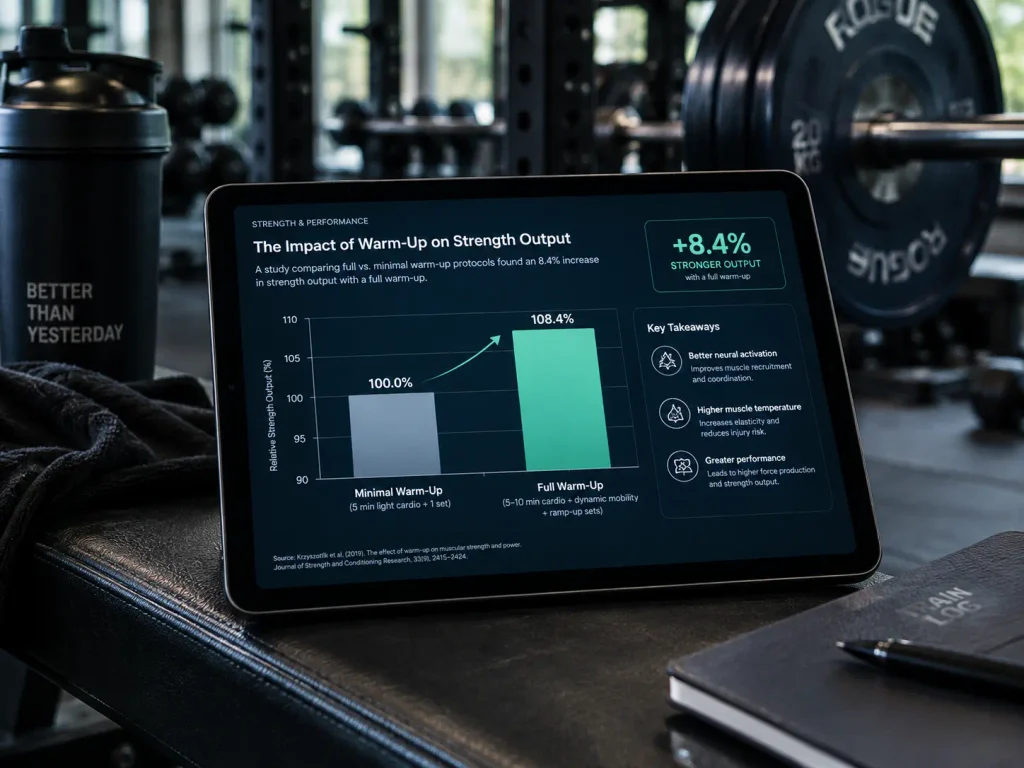
A controlled study on trained lifters, published on PubMed, found that combining a general warm-up (20 minutes of moderate cardio) with a specific warm-up (light sets of the actual lift) produced leg-press one-rep max results averaging 8.4% higher than a specific warm-up alone. The researchers attributed this to temperature-dependent neuromuscular changes that a general warm-up produces but a specific warm-up by itself doesn’t fully replicate.
That’s a meaningful edge for a maximal strength test. But other research complicates the picture: separate studies on trained lifters working in more typical training rep ranges — around 10 reps per set rather than a true 1RM attempt — have found specific warm-up alone performs similarly to no dedicated warm-up at all, suggesting the benefit of extensive warm-up may be most relevant for true maximal or near-maximal efforts, not everyday working sets.
Why “Warm Up More” Isn’t Always the Right Advice
This is exactly the kind of research that gets flattened into oversimplified gym wisdom. “Always warm up thoroughly” is reasonable advice before a heavy single, but it may be unnecessary time spent before a normal 8–10 rep working set, where the research shows far less clear benefit. The honest answer depends on what you’re actually about to lift, which is exactly why comparing full warm-up vs minimal warm-up yourself is more useful than following a blanket rule from a magazine or a coach who’s never seen your specific training.
My Own Experiment: Full Warm-Up vs. Minimal Warm-Up for 4 Weeks
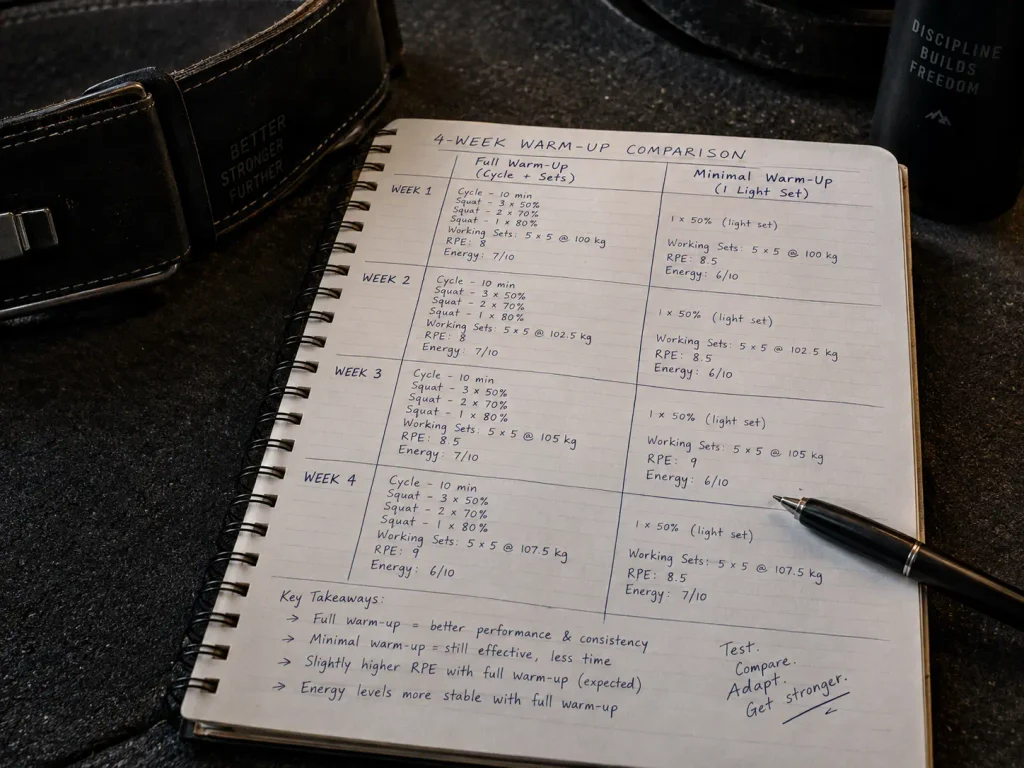
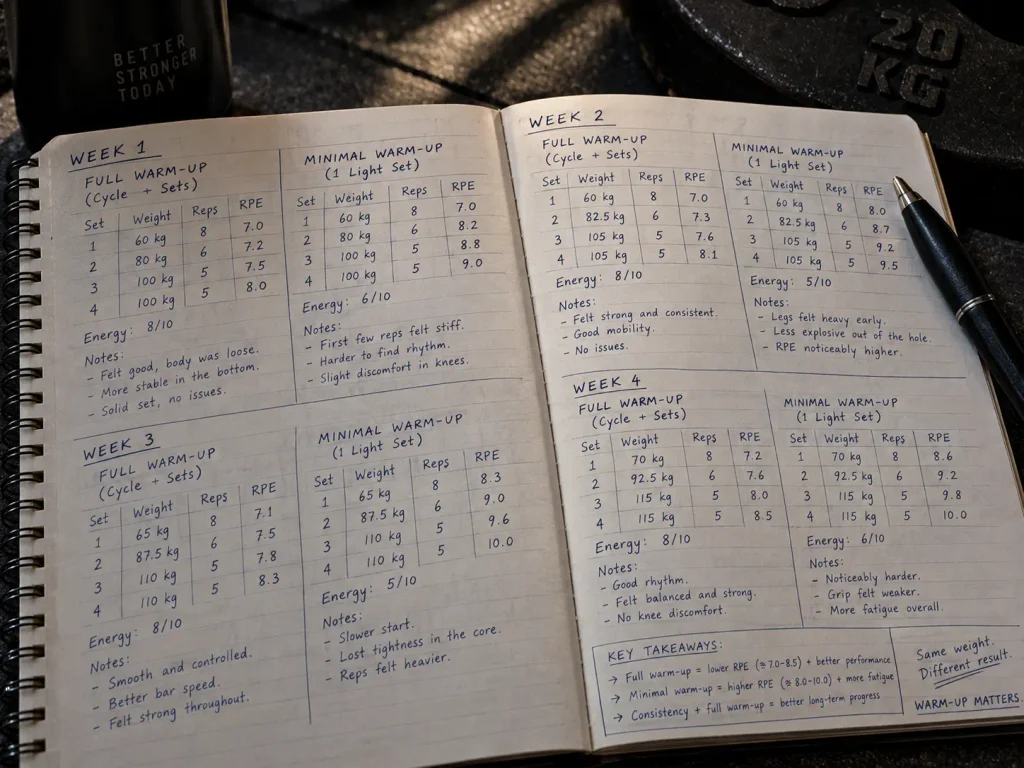
I used my squat as the tracked lift and alternated warm-up protocols weekly for four weeks. In “full warm-up” weeks, I did 5 minutes of easy cycling, then three graduated warm-up sets working up to my top set. In “minimal warm-up” weeks, I skipped the cardio and did just one light warm-up set before jumping to the same top working weight.
I chose the squat specifically because it’s the lift where I most suspected warm-up quality might matter — a heavy compound movement loading the hips, knees, and lower back simultaneously, unlike an isolated single-joint exercise where a cold start seems lower-risk. Running the comparison on a lift I already trained three times a week also meant I could gather enough sessions in each condition within a reasonable timeframe, rather than needing months to accumulate data on something trained only occasionally.
What I Tracked and How
For every session, I logged the working weight, reps completed, and RPE on my main squat set, along with a simple note on how the first few reps of the working set felt — smooth, or noticeably stiff. I kept the working weight identical across both conditions so RPE and rep quality were the only variables that could meaningfully shift.
The Results: Full Warm-Up vs. Minimal Warm-Up, Side by Side
The full warm-up weeks averaged an RPE around 7 on my main working set. The minimal warm-up weeks averaged closer to 7.8 at the identical weight — noticeably harder, though still completable with good form every time. The difference showed up most clearly in the first working set of the session; by the second or third set, the gap between conditions largely disappeared as my body warmed up naturally through the working sets themselves.
The “first few reps felt stiff” note I logged alongside RPE turned out to be just as informative as the number itself. On minimal warm-up days, that note appeared in nearly every session for the opening set. On full warm-up days, it showed up only once across the entire four weeks — a pattern that wouldn’t have been visible if I’d only logged the RPE number without any qualitative note attached to it.
This tracks closely with the research: the biggest advantage of a full warm-up showed up right when it mattered most — the first heavy attempt of the day — while the difference shrank once my body was already warmed up from training itself, similar to how the cardio-before-or-after-weights experiment found the interference effect concentrated in the first heavy lift rather than everything that followed.
Common Mistakes When Testing Full Warm-Up vs. Minimal Warm-Up Yourself
- Changing the working weight between conditions. Keeping the load identical is what makes RPE comparable — if the weight changes too, you can’t tell whether warm-up or load explains the difference.
- Only testing for one session per condition. Day-to-day variation in sleep and stress can easily be mistaken for a warm-up effect if you don’t repeat each condition multiple times.
- Ignoring how the first few reps specifically felt. The clearest signal in this experiment showed up in the opening reps of the working set, not necessarily the whole set’s average difficulty.
- Assuming the same result applies to every rep range. My experiment used a heavy-ish working set; the research suggests the warm-up effect may matter less at higher rep, lower-intensity work.
- Skipping the log and judging by feel alone. A half-point RPE gap is real and meaningful over weeks, but it’s genuinely hard to notice reliably without writing the numbers down.
How to Design Your Own Full Warm-Up vs. Minimal Warm-Up Experiment
Pick one heavy compound lift where warm-up quality plausibly matters most, like squat, deadlift, or bench press.
Define your two conditions clearly — for example, a full warm-up (general cardio plus graduated sets) versus a minimal one (a single light set).
Keep your working weight identical across both conditions, so RPE becomes the variable that actually reveals a difference.
Alternate conditions weekly for at least 3–4 weeks total, giving each condition multiple sessions rather than judging from a single day.
Log RPE and how the first few reps felt specifically, since that’s where any real warm-up effect is most likely to show up first.
Why This Self-Experiment Approach Beats a Generic Rule
Warm-up advice online tends to fall into two unhelpful camps: “always warm up thoroughly, no exceptions” or “warm-up doesn’t really matter, just start lifting.” Neither survived contact with the actual data from testing full warm-up vs minimal warm-up on my own squat. The truth sat in between, and it only became visible because I tracked RPE instead of relying on how a session felt in the moment.
This is really the same lesson that kept showing up across every self-experiment on this blog: the number you choose to track determines what you’re able to learn. If I’d only judged warm-up quality by whether I could complete my sets, both conditions would have looked identical — completable, no failed reps, no obvious problem. RPE was the only variable sensitive enough to reveal the actual difference, the same pattern that showed up in the cardio-order experiment and the deload timing test.
How to Apply This If You Don’t Want to Run the Full Experiment
Not everyone wants to spend four weeks alternating conditions before making a decision, and that’s fine — the research and this full warm-up vs minimal warm-up comparison both point toward a reasonable default you can use immediately. Save the full warm-up for your heaviest compound lift of the day, the one where a near-maximal or genuinely challenging top set is on the schedule. For everything after that first hard lift, a shorter warm-up is very likely enough, since your body is already primed from the work you just did.
This matches what showed up in my own numbers almost exactly: the RPE gap between full warm-up vs minimal warm-up was real and consistent on the very first heavy set of the session, then quietly closed itself out by the second or third set regardless of which warm-up protocol I’d used that day. If you only have time to warm up properly once, that first lift is where it counts most.
Frequently Asked Questions About Full Warm-Up vs. Minimal Warm-Up
Does warm-up matter more for heavier lifts?
Yes, based on both the research and this full warm-up vs minimal warm-up experiment. The strength benefit of a thorough warm-up appears most clearly around maximal or near-maximal efforts, with a smaller, less consistent effect at moderate rep ranges.
How long should a full warm-up actually take?
The research showing the largest benefit used about 20 minutes of general cardio plus a handful of graduated specific warm-up sets — but for everyday training rather than a true max attempt, a shorter version is likely sufficient based on how quickly the RPE gap closed in this experiment.
Is a minimal warm-up ever risky?
For working sets well below your true max, a light warm-up set or two appears sufficient in the research and in this experiment. For a genuine 1RM attempt, skipping a fuller warm-up risks both reduced performance and a less controlled first heavy rep.
Can I use this same method to test other training variables?
Yes. The core structure — identical load across two conditions, alternating weekly, tracking RPE alongside the hard numbers — is the same approach used in the cardio-order self-experiment and works for almost any training variable you want to isolate, not just full warm-up vs minimal warm-up specifically.
Does the type of general warm-up matter?
The research primarily tested cycling, but the underlying mechanism — raising muscle temperature before specific work — suggests other low-impact cardio options like an easy row or incline walk would likely produce a similar effect.
Should I always do a full warm-up just to be safe?
For a genuinely heavy top set, yes, based on the data. For lighter accessory work or higher-rep sets, the time may be better spent elsewhere, since the measurable benefit shrinks significantly outside of near-maximal effort.
How is this different from just stretching before lifting?
This experiment and the underlying research focus on active warm-up — light cardio and graduated lifting sets — not static stretching, which separate research has shown can actually reduce explosive strength output if done immediately before a heavy set.
Final Thoughts on Full Warm-Up vs. Minimal Warm-Up
The honest answer sits between “always warm up fully” and “warm-up doesn’t matter” — a full warm-up genuinely helped on my heaviest working sets, while the gap largely disappeared once my body warmed up naturally through the session itself. Testing full warm-up vs minimal warm-up on your own key lifts, rather than following a blanket rule, tells you exactly where that line sits for your own training.
Comece hoje mesmo: pick one heavy lift, alternate a full and minimal warm-up across your next few sessions at the identical working weight, and log your RPE. Four weeks of running your own full warm-up vs minimal warm-up comparison will tell you more than any generic warm-up rule ever could.