
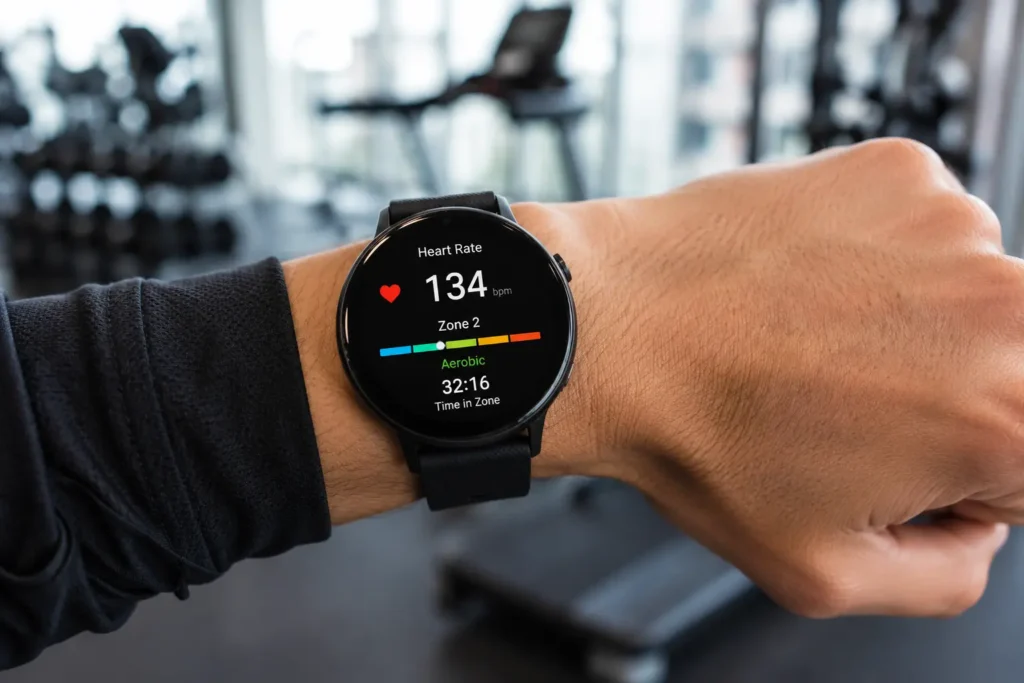
Quick answer: Zone 2 training for lifters means low-intensity cardio — roughly 60–70% of max heart rate, or a pace where you can hold a conversation with some effort — done for 30–45 minutes to build an aerobic base without interfering with strength or muscle gains. You don’t need a lab lactate test to find it; the talk test and a heart rate range are accurate enough for almost everyone.
Zone 2 has become one of the most talked-about cardio methods in longevity and endurance circles, popularized by researchers like Iñigo San-Millán. What rarely gets discussed is how zone 2 training for lifters — someone whose main priority is strength, not endurance — should actually work, and how to know your zone without paying for a lab test.
Table of Contents
What Is Zone 2 Training for Lifters, and Why Does It Matter?
Zone 2 training is low-intensity aerobic exercise performed at roughly 60–70% of your maximum heart rate, an intensity where your body relies primarily on fat oxidation and lactate stays low and stable rather than accumulating. It’s named for the second of five commonly used heart rate training zones.
The reason it matters goes beyond simple cardio conditioning: exercise at this intensity is a strong stimulus for mitochondrial biogenesis — literally building more of the cellular structures that produce energy in your muscles. A 2025 systematic review and meta-analysis of randomized trials, published on PubMed, confirmed that endurance-style exercise produces a significant, measurable increase in the key marker of this process across the studies reviewed.
For lifters specifically, more mitochondrial density means better recovery between sets, less fatigue during high-volume training blocks, and a cardiovascular system that supports your lifting rather than working against it.
How to Find Your Zone 2 Without a Lab Test
The standard “220 minus your age” heart rate formula is a rough population average that tends to underestimate max heart rate in people who train regularly — which describes most lifters. Instead of relying on it alone, combine it with the talk test for a far more accurate real-world zone.
Calculate a rough starting range. Take 220 minus your age for an estimated max heart rate, then multiply by 0.6 and 0.7 to get your zone 2 range.
Use the talk test to verify it. At the right intensity, you should be able to speak in full sentences, but with some noticeable effort — not silent, and not chatting easily.
Adjust based on how the pace actually feels. If your heart rate sits in the calculated range but you’re breathing hard and struggling to talk, the formula is likely overestimating your max heart rate — slow down and trust the talk test over the number.
Note the pace or effort that matches, whether that’s a walking speed, an incline, or a bike resistance level, so you can replicate it session to session.
Zone 2 Training for Lifters: How Much Do You Actually Need?
Research on endurance athletes suggests 3–5 hours per week of zone 2 work drives meaningful mitochondrial adaptation, but that volume isn’t realistic or even necessary for most people doing zone 2 training for lifters, since their main training goal is strength, not endurance performance.
For lifters, a more practical minimum effective dose is 2–3 sessions of 30–45 minutes per week. This won’t match the aerobic development of a dedicated endurance athlete, but it’s enough to meaningfully improve recovery capacity and cardiovascular health without competing for the recovery resources your lifting depends on.
Best Zone 2 Training Modalities for Lifters
The best zone 2 modalities for lifters are low-impact, easy to control, and don’t add fatigue to muscle groups you’re training heavily that week.
| Modality | Best For | Notes |
|---|---|---|
| Incline treadmill walking | Beginners, joint-friendly option | Easy to control pace precisely |
| Rowing machine | Full-body, upper-back friendly | Watch that intensity doesn’t creep into zone 3 |
| Stationary bike | Leg-day-adjacent days | Lower impact than walking on tired legs |
| Outdoor walking or hiking | Free, no equipment | Harder to control pace precisely without a watch |
| Swimming | Full-body, zero impact | Requires pool access and some technique |

If you’ve already read our guides on rucking or Japanese walking, you’ll notice both naturally fall in or near zone 2 for most people — they’re not a separate category so much as specific, lifter-friendly ways of doing this same type of training.
How to Track Zone 2 Training Progress
Track zone 2 training the same way you’d track any other training method: log the modality, duration, average heart rate, and the pace or effort level, then look for a specific trend called aerobic decoupling — your pace or power output improving over time at the same heart rate.
A simple log might include:
- Modality and duration: e.g., incline treadmill, 35 minutes
- Average heart rate: stayed within your calculated zone 2 range
- Pace, incline, or resistance: the actual output at that heart rate
- Date: to compare the same conditions 4–8 weeks later
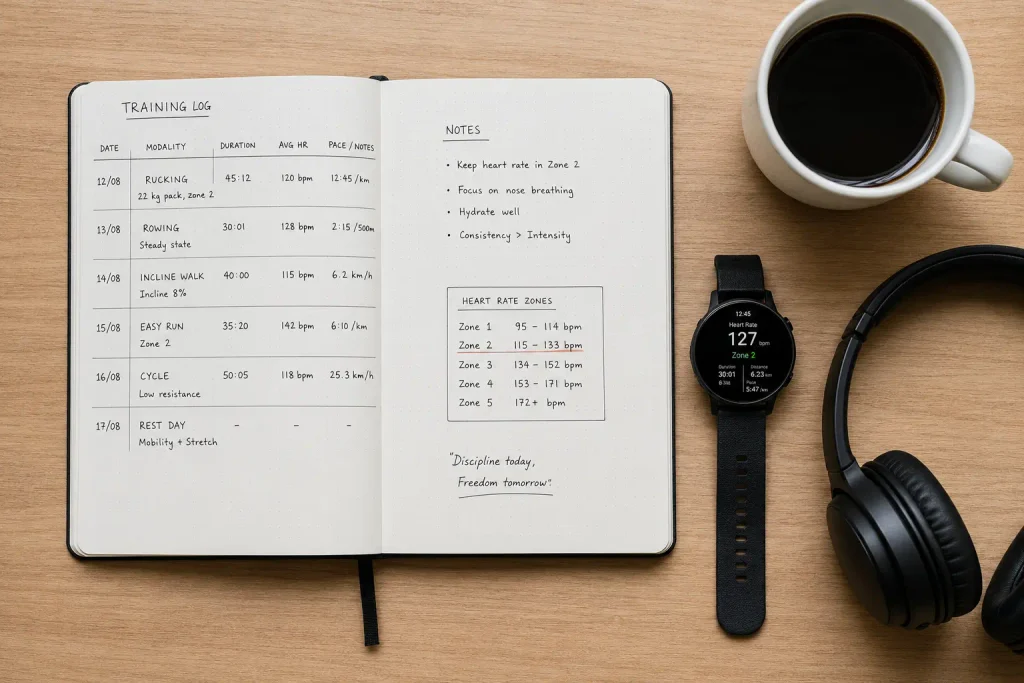
Retest under similar conditions every 4–8 weeks. A 5–15% improvement in pace or output at the same heart rate over that period is a realistic sign that your aerobic base is genuinely improving — the same gym performance tracking principle applied to cardio instead of your main lifts.
My Own Test: 4 Weeks Finding My Real Zone 2 Training for Lifters Range
I started with the standard formula: 220 minus my age, times 0.6–0.7. On paper, that gave me a target heart rate range that felt suspiciously easy on the treadmill — I was barely working, well below anything resembling real effort, yet my watch said I was already at the top of the calculated range.
I ignored the number for one session and used the talk test instead: I pushed the incline and pace until talking in full sentences took genuine effort. My heart rate at that point was noticeably higher than the formula’s “zone 2 ceiling” — a gap of about 10 beats per minute, which matches exactly what the research on trained individuals predicts.
By week 4, using the talk-test-adjusted range consistently, my pace at the same heart rate had measurably improved — I was walking faster at an incline that used to leave me breathless at a slower pace. That single data point, tracked and compared honestly, was far more convincing than any generic heart rate formula could have been on its own.
Common Mistakes With Zone 2 Training for Lifters
These mistakes are what turn a genuinely useful cardio method into wasted time or, worse, interference with the strength gains you’re actually trying to protect.
These mistakes are what turn a genuinely useful cardio method into wasted time or, worse, extra fatigue that eats into your lifting recovery.
- Trusting the 220-minus-age formula blindly. As my own test showed, it commonly underestimates max heart rate for people who train regularly, pushing your “zone 2” into what’s actually zone 3.
- Doing zone 2 sessions too hard. If you can’t hold a conversation, you’re not in zone 2 anymore — the whole point is sustainable, low-stress aerobic work.
- Scheduling it right before or after your heaviest lifting session. Even low-impact cardio adds some fatigue; separating it from your hardest training days protects your main lifts.
- Expecting fast results. Aerobic base adaptations, including the mitochondrial changes zone 2 targets, build over months, not single sessions.
- Ignoring modality variety. Rotating between walking, rowing, and cycling reduces repetitive strain compared to doing the exact same movement every session.
How Often Should Lifters Do Zone 2 Training?
Two to three sessions of 30–45 minutes per week, scheduled away from your heaviest lifting days, works well for most lifters looking to build a meaningful cardio base without sacrificing strength progress. This frequency delivers real cardiovascular benefit while staying well within what most training schedules can realistically absorb.
Is Zone 2 Training Actually Worth Your Time as a Lifter?
It’s fair to be skeptical. Zone 2 training doesn’t produce the immediate feedback of a heavier squat, and the payoff — better recovery capacity, a stronger cardiovascular base — is genuinely slow to show up. If your only goal is maximum strength in the shortest time, an extra hour or two of zone 2 training for lifters each week is a real time cost, not a free win, and it’s worth weighing honestly against your actual priorities.
Where it pays off is in the margins that matter over a training career, not a single mesocycle: fewer wasted sets because you’re gassed halfway through a heavy session, faster recovery between training days, and a body that can handle higher training volumes without your cardiovascular system becoming the limiting factor. For most lifters training for years rather than weeks, that trade is worth making.
Frequently Asked Questions About Zone 2 Training for Lifters
Is the 220-minus-age formula accurate for lifters?
Not always. It’s a population-average estimate that tends to underestimate max heart rate in people who train regularly, which often pushes the calculated zone 2 range too low. Combining it with the talk test gives a much more reliable result.
Can zone 2 training interfere with my strength gains?
At 2–3 sessions per week and a genuinely low intensity, most lifters see no meaningful interference with strength progress. Interference becomes more likely at higher volumes or when zone 2 sessions creep into higher intensities.
Do I need a heart rate monitor for zone 2 training?
It helps for precision, but it isn’t required. The talk test alone — maintaining conversation with noticeable but manageable effort — gets most people close enough to genuine zone 2 intensity.
How is zone 2 training different from rucking or Japanese walking?
They overlap significantly. Rucking and Japanese walking are both specific methods that, done at the right intensity, naturally land in or near the zone 2 heart rate range — think of zone 2 as the underlying principle and those methods as two lifter-friendly ways to apply it.
How long before I see benefits from zone 2 training?
Measurable improvements in pace or output at the same heart rate — a sign called aerobic decoupling — typically show up over 4–8 weeks of consistent training, with continued gains over months.
Can I do zone 2 training on the same day as leg day?
It’s better to avoid it directly before or after a heavy leg session, since even low-impact cardio adds some cumulative fatigue. Scheduling it on upper-body or rest days works better for most lifters.
Is zone 2 training worth it if I only care about strength, not longevity?
Yes, though for a different reason than the longevity crowd emphasizes. Better mitochondrial density and cardiovascular capacity translate directly into faster recovery between sets and less fatigue during high-volume training blocks, which supports strength goals too.
Final Thoughts on Zone 2 Training for Lifters
Zone 2 training for lifters doesn’t need a lab, a coach, or an expensive wearable subscription to get right. A rough heart rate calculation, honest use of the talk test, and consistent tracking of your pace over time tell you everything you actually need to know.
Start today: calculate your rough zone 2 heart rate range, then go for a 30-minute walk or bike ride, checking in with the talk test the entire time. Log your heart rate, pace, and how the conversation felt — that’s your first real data point in zone 2 training for lifters.