Quick answer: Research generally favors doing weights before cardio when strength is your priority, since resistance-then-endurance order showed a measurable strength advantage in controlled studies. But group averages don’t guarantee your individual response, so the most reliable answer comes from a short, tracked self-experiment comparing both orders in your own training log.
Ask ten lifters whether cardio should come before or after weights and you’ll get ten confident, contradictory answers. Most of them will end with “it depends on your goals” — technically true, but not actually useful when you’re standing in the gym deciding what to do next. The research gives a real, specific answer for strength outcomes, and testing cardio before or after weights against your own body gives you the rest.
Índice
What the Research Actually Shows on Cardio Before or After Weights
A systematic review and meta-analysis examining intra-session exercise sequence, published in Sports Medicine and available via PMC, found that doing resistance training before endurance exercise produced a 6.91% greater improvement in lower-body dynamic strength compared to the reverse order, across studies lasting five weeks or longer — one of the clearest data points available on cardio before or after weights. The same review found no meaningful difference in muscle hypertrophy or lower-body static strength based on exercise order.
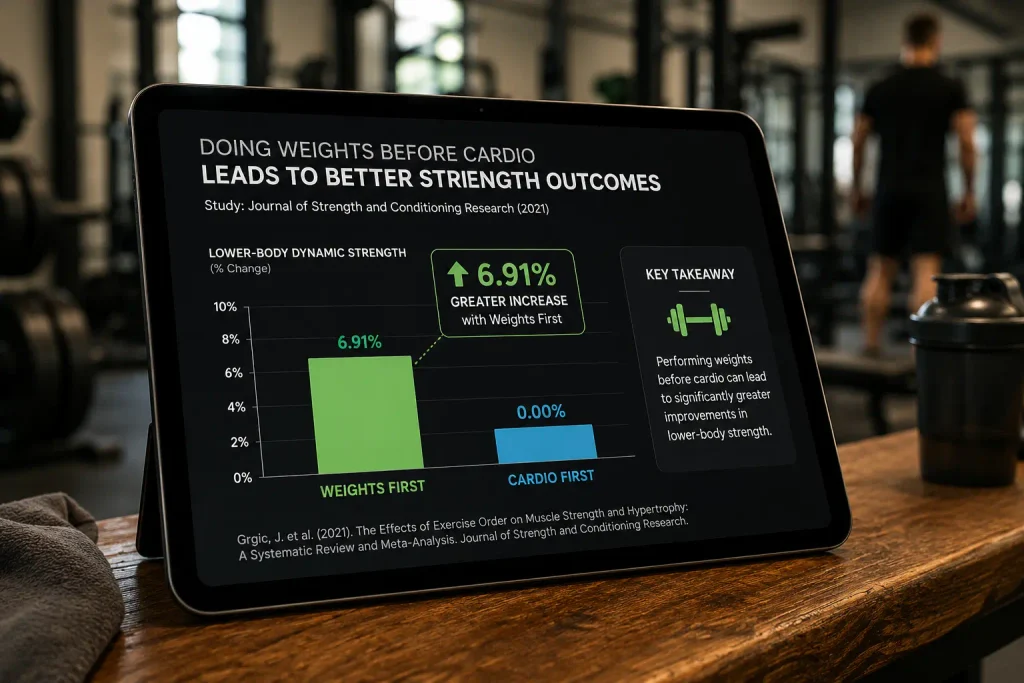
In plain terms: if your main goal is building dynamic strength — the kind of strength that shows up in a heavier squat or deadlift — doing your resistance training first gives you a real, measurable edge. If your priority is cardiovascular fitness or you’re not chasing a specific numeric goal, exercise order appears to matter far less than most gym debates suggest.
Why “It Depends on Your Goal” Isn’t a Complete Answer
The research settles the group-average question reasonably well, but “weights first for strength” doesn’t account for how your specific body, schedule, and recovery capacity actually respond. Two lifters following identical advice can have completely different experiences: one feels no different either way, while another notices their squat numbers clearly suffer when cardio comes first.
This is exactly the gap that monitoramento de desempenho na academia is built to close. Research tells you the most likely outcome across large groups of people; a short, honest self-experiment tells you what’s actually true for the person doing the lifting.
How to Test Which Order Works Better for You
Running your own exercise-order experiment takes about two to three weeks and requires nothing more than your existing training log.
Pick one key lift to track, ideally a main compound movement like squat, deadlift, or bench press that you train regularly.
Run 4–6 sessions with weights first, cardio after. Log your working weight, reps, and RPE for the tracked lift each session.
Run 4–6 sessions with cardio first, weights after, using a similar cardio duration and intensity — zone 2 training or a short rucking session both work well for this comparison.
Keep everything else as consistent as possible — sleep, nutrition, and total session length — so the exercise order is the main variable actually changing.
Compare your logged numbers directly. Look for differences in working weight, rep quality, and RPE at the same load between the two conditions.
What to Track During Your Order Experiment
- Working weight and reps on your chosen key lift, for every session in both conditions
- RPE (rate of perceived exertion) immediately after the lift, on a 1–10 scale
- Perceived energy level going into the resistance portion, rated simply as high, medium, or low
- Total session time, since one order might genuinely take longer depending on your gym’s setup
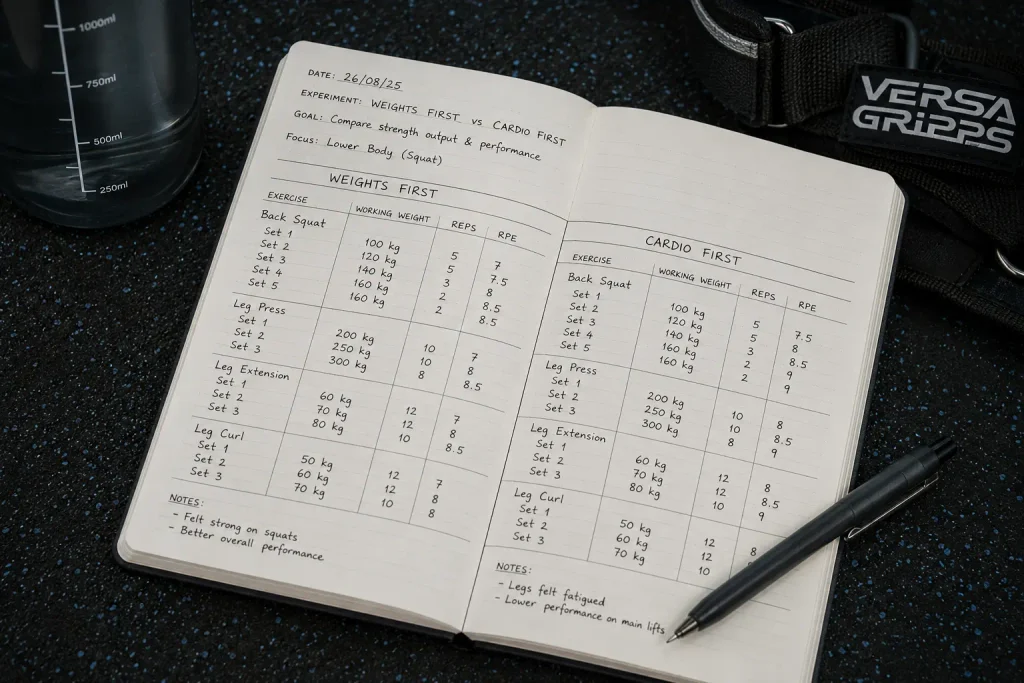
A simple two-column log — one for “weights first” sessions, one for “cardio first” — makes the comparison easy to read at a glance once you have a few sessions logged under each condition.
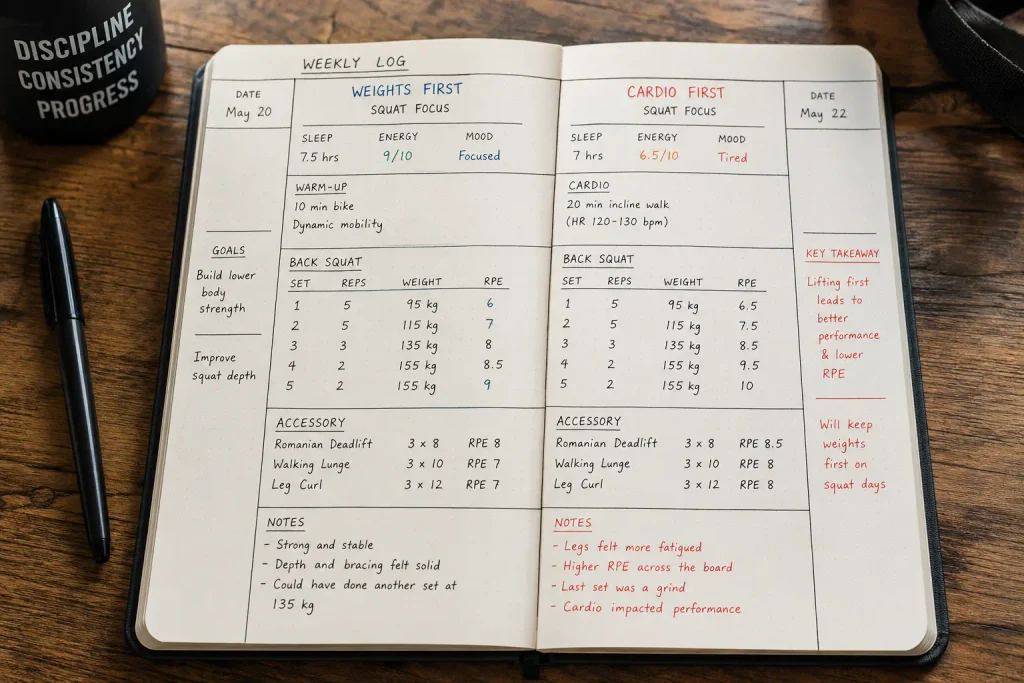
My Own Test: 4 Weeks Comparing Cardio-First vs. Weights-First
I used my squat as the tracked lift and ran two weeks of each order, alternating weekly to reduce the chance that simple week-to-week improvement was skewing the comparison. In the weights-first weeks, my squat RPE at a fixed working weight averaged around a 7. In the cardio-first weeks, using 20 minutes of zone 2 work beforehand, that same weight consistently felt like an 8–8.5.
The gap wasn’t dramatic on any single day, which is exactly why testing this by feel alone had never given me a clear answer before. It only became obvious once I had the numbers sitting side by side in the log — a consistent, half-point-to-full-point RPE difference at identical weight, session after session, is a real signal, not noise.
What surprised me most was that my accessory lifts later in the session showed almost no difference between conditions. The interference effect, at least for me, was concentrated specifically in the first heavy compound lift of the day — which matches the research’s finding that the effect shows up most clearly in dynamic strength on the primary movement, not necessarily everything that follows it.
Common Mistakes When Testing Cardio Before or After Weights
These mistakes are what make the cardio before or after weights question feel unanswerable, when a slightly more careful test usually settles it within a few weeks.
- Testing for only one or two sessions per condition. Day-to-day variation in sleep, stress, and nutrition can easily overwhelm a real exercise-order effect if you don’t test each condition multiple times.
- Changing the cardio type or intensity between conditions. Comparing a hard sprint session against an easy walk isn’t a fair test of order — keep the cardio itself as consistent as the lifting.
- Ignoring RPE and only tracking weight moved. As my own test showed, the interference effect can show up as increased effort at the same weight well before it shows up as an inability to lift that weight at all.
- Drawing conclusions from a single lift and generalizing to everything. Your squat and your bench press might respond differently to the same exercise order — test the lifts you actually care most about.
- Ignoring cardio duration entirely. Short, low-intensity sessions like a 15-minute walk are far less likely to interfere than a long, hard cardio block, regardless of which order you choose.
What If You’re Short on Time and Can Only Do One Order?
If time constraints mean you can only reliably run one order, default to weights first, since it carries the research-backed advantage for strength outcomes without a meaningful downside for hypertrophy or general fitness. This default is a reasonable starting point precisely because it matches what the evidence favors on average, even without running your own comparison.
Does Cardio Before or After Weights Matter for Every Type of Training?
Not equally. The interference effect studied in the exercise-order research is strongest for lower-body dynamic strength — squats, deadlifts, leg press — and far less relevant for upper-body lifts, since running or cycling fatigues the legs specifically, not the arms or chest. If your priority lift that day is bench press or an overhead press, cardio before or after weights is unlikely to matter much either way.
This also means the answer can change exercise by exercise within the same session. You might genuinely benefit from doing your squats before cardio while your bench press session is fairly indifferent to the order, which is exactly the kind of nuance a group-average study can’t capture but your own tracked log can.
What This Means for Your Weekly Training Split
If you train multiple times per week, you don’t need to pick a single order and apply it to every session forever. A common, practical approach is defaulting to weights first on your heaviest lower-body days — squat or deadlift sessions — while being more flexible about order on upper-body or accessory-focused days where the research shows the interference effect matters far less.
This is also where rucking fits neatly into the conversation. Since rucking is lower-impact than running, it’s a reasonable cardio choice for days when you want to test cardio before weights without stacking on the higher-impact fatigue that running specifically has been shown to add to subsequent leg-strength performance.
Frequently Asked Questions About Cardio Before or After Weights
Does the order matter more for beginners or advanced lifters?
The research doesn’t show a clear split by experience level, but advanced lifters training closer to their strength ceiling may notice smaller performance differences more readily, simply because their margin for extra fatigue is thinner.
Does cardio type change the answer?
Yes, to some degree. Running before lifting has shown more consistent negative effects on subsequent leg-strength performance than cycling, likely due to the greater muscular fatigue and impact involved in running.
How long should my cardio be to avoid interfering with weights?
Shorter, lower-intensity sessions (15–20 minutes at an easy pace) generally interfere less than longer or higher-intensity sessions, regardless of which order you choose.
Should I always do weights first from now on?
For strength-focused goals, it’s a reasonable default backed by research, but running your own short experiment is the only way to know whether your body is an exception to that general cardio-before-or-after-weights pattern.
Does exercise order affect muscle growth the same way it affects strength?
No. The same research found no meaningful difference in hypertrophy based on exercise order, so this decision matters most if your specific goal is maximizing strength rather than muscle size.
Can I do cardio and weights on completely separate days instead?
Yes, and this sidesteps the interference effect entirely for that specific session, though it requires more total training days per week to fit both types of training in.
How do I know if my results are a real pattern or just random variation?
Look for consistency across at least 4–6 sessions per condition. A difference that shows up repeatedly, in the same direction, at the same or similar loads, is far more trustworthy than a single unusual session — and that consistency is really the entire point of testing cardio before or after weights yourself instead of just picking a side in the debate.
Final Thoughts on Cardio Before or After Weights
The research gives a genuinely useful default — weights first, if strength is your priority — but it can’t tell you exactly how your body responds. Running a short, tracked comparison using the same sobrecarga progressiva mindset you already apply to your lifts turns a gym debate into an answer you can actually trust.
Comece hoje mesmo: pick your next four sessions, alternate the order, and log your key lift’s weight, reps, and RPE each time. In two weeks, you’ll have your own answer to cardio before or after weights — not just the group average.